Showing posts with label Have Not Been the Same. Show all posts

Thursday, March 18, 2021

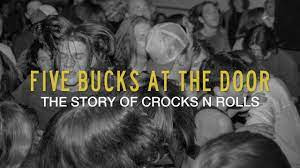
Crocks N Rolls: Five Bucks at the Door


Frank Loffredo
photo by Brent Linton
FIVE BUCKS AT THE DOOR

The Story of Crocks N Rolls

Directed by Kirsten Kosloski

I once co-wrote a book about Canadian music from 1985-95. It talked about a lot of people, a lot of places from coast to coast. After watching Kirsten Kosloski’s new documentary Five Bucks at the Door (link to full film below), I realize I could have set the entire book in Thunder Bay, at a bar called Crocks N Rolls. The main character, as it is in the film, would be the club’s owner, Frank Loffredo.

If you were a touring Canadian musician in the late '80s and early '90s, you played at Crocks N Rolls. You had to. The distance between Toronto and Winnipeg is 21 hours. Sudbury and Winnipeg: 18 hours. Hell, even between Sault Ste. Marie and Winnipeg is 14 hours. You have to stop in Thunder Bay

You’d be happy to see it. And the approximately 300 freaks and weirdos who live there, surrounded by thousands of hockey players and hunters, were more than happy to see you. Frank Loffredo is the guy who ran it, booked it, and literally slept there to keep it going. His wife (and mother to their three children) worked late shifts at the bar before getting up at seven in the morning for her day job as a nurse. Loffredo wanted to create a community, a refuge for both local outcasts and travelling artists, located at the tip of fabled rock’n’roll roadway Highway 61. He succeeded.

Kosloski grew up as a nerdy, shy kid who taped CBC’s Brave New Waves late at night and listened to it on the bus to school the next day--so she’s already someone after my own heart. The first night she goes to Crocks N Rolls, when she’s 16, her life changes. The fact that she was allowed in is itself a miracle: all-ages shows in bars were hardly the norm anywhere else in Canada. (I had to grow a beard to have a similar experience in Toronto, at the same age.) There, she sees all kinds of freaks: NoMeansNo, Bob’s Your Uncle, Jr. Gone Wild, Change of Heart, Bob Wiseman, Rheostatics, the Inbreds, 13 Engines, Furnaceface, Acid Test. Years later, she interviews them all for her film.


Even if I didn’t write a similar book, can I possibly be objective about this film? I’m between the ages of 45 and 55, had my life changed by Brave New Waves, went to see way too much live music, and my main goal in life when I was 25 was to tour Canada. Which I did--but Crocks N Rolls happened to close the very week my band left on tour. So we drove from Sudbury to our next gig… in Regina (ouch). But the fact I never entered its doors doesn’t diminish the effect this film has on me. This is as nostalgic as I can possibly feel about a place I’ve never been to.

This film is clearly a love letter to the wonderfully weird side of Thunder Bay (which is a welcome respite from the avalanche of horror stories out of the city in recent years; for better or worse, that aspect of the city is not addressed here). The queers, the punks, the metalheads, the jam bands, the tree-planters: all were welcome, with girls to the front. But it’s also an ideal microcosm for every Canadian city that isn’t Montreal, Toronto or Vancouver. If you’re lucky, your town had that one club, or one arts space, or one radio station or record store, that acts as a hub, a lifeline and a pipeline to the outside world. Some use it as a launching pad for escape; some use it to empower a local existence. God bless those like Loffredo, who stick around, who make something happen, who don’t give up on the place that they live.

Kosloski brings the story to life not just with candid chats with Loffredo and the artists mentioned above, but with a wealth of photos and original animation. She also puts herself in front of the camera, a technique I normally find grating unless absolutely necessary--which she is. She’s the heart of this story, even more so than Loffredo; without her testimonial, his story would be far less effective. And her (perhaps too long) tribute to Brave New Waves is perfect (and therefore not a single second too long): the national radio show helped her imagine a bigger world, and Crocks N Rolls brought it to her directly. I grew up in a suburb of the biggest city in the country, and even I know what it feels like to find those lifelines. She makes a strong case for how much more important those things are when the next town is an eight-hour drive in any direction.


I loved this film. If you’ve read either Have Not Been the Same or The Never-Ending Present, or listened to Brave New Waves during the Brent Bambury years, or watched Bruce McDonald's trilogy of Roadkill / Highway 61 / Hard Core Logo, I can guarantee you’ll love it as well. (You’re also likely to be a dear friend of mine.)

I have a few minor quibbles: there’s some minor repetition in the storytelling (not uncommon in current docs), and there’s some Thunder Bay inside baseball that’s not fully explained: Who is that guy? Why was his band important? But to be fair, those locals don’t resonate for me only because I know all the other talking heads extremely well, some of them personally. If you came to this film cold--as a mainstream music fan, as a non-Canadian, or even as a Canadian under 40--the composite portrait is still effective. And while obviously it would be great to have had more video footage, Kosloski does a fantastic job with photographs--and the fact she doesn’t have much video makes the whole time period seem further away than it actually is, therefore more exotic. (The amazing photos, by Brent Linton, are in vivid B&W.)

It’s such a tired cliche of historians talking about events from 30 years ago to provide qualifiers about how “of course, this was pre-Internet”--but it’s a tired cliche that’s entirely necessary, especially here. This really does seem like ancient history now. As Sook-Yin Lee points out in the film, it’s ephemera in dire danger of fading away entirely. 


So thank you, Kirsten Kosloski, for capturing Crocks N Rolls. It’s unlikely we’ll get films or books or oral histories about similar venues across the country unless it’s the Commodore Ballroom or Massey Hall, but maybe that’s okay.

Maybe the story of Crocks N Rolls says it all.

A Calgary Herald story by Eric Volmers is here.

Watch the whole glorious goddam thing here:


Monday, October 20, 2014

Canadian songbook: Zunior, Oh Susanna, Grey Lands


Canada has always been known as a songwriters’ nation, ever since the days of Ian and Sylvia, Gordon Lightfoot, Joni Mitchell and the rest of Yorkville scored hits via covers of their songs, even before their own careers took off. (You should read about this scene in Jason Schneider's excellent book Whispering Pines.) And yet, we rarely celebrate our modern songbook: for all the camaraderie and cross-pollination our best artists do, they rarely, if ever, cover each other’s work.


Earlier this year, Montreal songwriter Michael Feuerstack enlisted a bunch of his considerably more famous friends to cover some of his songs. Geoff Berner did the same thing, assembling a tribute album to himself to help launch his first novel. This fall, Great Lake Swimmers’ Tony Dekker, Cuff the Duke’s Wayne Petti and Oh Susanna continue the trend, covering their favourite songs and songwriters. (See reviews, below.)


Three years ago, I assembled a compilation of my favourite modern artists covering Canadian songs from 1985-95, a time period covered in my co-authored book, Have Not Been the Same. It’s an amazing record. Kevin Drew. Corb Lund. Hidden Cameras. Bry Webb. Great Lake Swimmers. Jill and Matthew Barber. The Burning Hell. Jim Bryson. Forest City Lovers. Cuff the Duke. Mark Davis. Selina Martin. Light Fires. Snailhouse. Veda Hille. Andrew Vincent. Geoff Berner. Bruce Peninsula’s Neil Haverty. Arcade Fire’s Richard Reed Parry. You should buy it. All proceeds go to CAMH.


I chose to put out that compilation via Zunior, the online record label and e-retailer run by the Inbreds’ Dave Ullrich. For 10 years now, he’s been selling independent Canadian music at decent prices (albums are $8.88), paying artists much more than they’d make through iTunes or other American outlets. All the major and minor indies are there: Arts and Crafts, Paper Bag, Constellation, Nettwerk, Kelp, Mint, Secret City, Six Shooter, Sonic Unyon, Weewerk, You’ve Changed, White Whale, Flemish Eye, and much more—even Jagjaguwar, a U.S. label with plenty of Canucks on it. If you buy indie Canadian music, you should buy it from Zunior. It’s also Stuart McLean’s preferred retailer; all his Vinyl CafĂ© products are available there.


Zunior also curates new compilations, usually around Christmas: one year featured its artists covering the Charlie Brown Christmas album in its entirety. This year, however, to celebrate its 10th anniversary, Zunior put out a cookbook, organized a festival, and commissioned a comic book. Zunior also got their BFF Tony Dekker, of Great Lake Swimmers, to cover some of his favourite Canadian songs of the last 10 years. The result? It’s almost as good as my album. ;)


These reviews ran in the Waterloo Record last month.


Tony Dekker – Sings 10 Years of Zunior (Zunior)


Great Lake Swimmers’ Tony Dekker has always tossed out oddball covers that counter his reputation as a sad-eyed, dreamy crooner. (Perhaps you once heard him on CBC Radio covering the Dead Kennedys’ satirical classic “Kill the Poor.”) Here, he celebrates the anniversary of Zunior; their 10 years as a business happen to coincide with an incredible decade of Canadian music, and so Dekker has plenty of incredible material to choose from.


Other than Chad Van Gaalen and Martin Tielli, neither of whose work is much different than Dekker’s day job, Dekker goes for the underdogs: Christine Fellows, The Burning Hell, Rae Spoon, Old Man Luedecke, Ohbijou. He also gives two nods to Guelph, covering Jim Guthrie’s “3AM” and Jenny Omnichord’s “Growing Too.” The one WTF moment is a silly and strange cover of Cadence Weapon’s “Do I Miss My Friends”—you may not think Tony Dekker should be rapping, and maybe he shouldn’t, but it has to be heard to be believed.


Dekker could have made this record in his sleep; he didn’t. He invests the same time and care he would on one of his own records; it’s obvious this is a complete labour of love. It’s also essential listening not just for Great Lake Swimmers, but for anyone who cares about the Canadian songbook. Your favourite acts of the last 10 years didn’t, with few exceptions, rise in isolation. They came from a community, and this is one man’s version of what that community sounded like. I can’t think of a better man for the job .


Download: “At the Airport” (Old Man Luedecke), “My Sweet Relief” (Martin Tielli), “The Woods” (Ohbijou)


Oh Susanna – Namedropper (Sonic Unyon)


For her sixth album, Oh Susanna commissioned her many talented friends to write songs for her, enlisting Joel Plaskett, Jim Cuddy, Ron Sexsmith and more. How could she go wrong?


She can’t. She enlisted producer Jim Bryson—who also happens to trump everyone else here by penning the album’s highlight and opening track, “Oregon”—and some of the songwriters into her backing band (as well as Kathleen Edwards, who, sadly, doesn’t contribute a song). Perhaps it goes without saying that Plaskett writes the album’s other surefire classic, “Into My Arms.” Amelia Curran, Melissa McClelland (Whitehorse), Old Man Luedecke and Royal Wood also stand out; Jay Harris’s “1955” has one of the catchiest melodies but some of the most unfortunate lyrics (it’s a peppy love song with the chorus: “Your love’s like suicide/ the kind of love you can only buy / 1955.” What do those three things have to do with each other, and why are they set to a country-rock anthem?)


Dropping names, stacking the deck, and being shameless about it—no harm in that, especially with company like this.


Download: “Oregon,” “Into My Arms,” “Mozart for the Cat”


Grey Lands – Songs by Other People (Paper Bag)


Grey Lands is a new solo project for Cuff the Duke’s Wayne Petti; the title of the debut album is self-explanatory. Here, Petti dips into psychedelic country in ways I’d been hoping he would ever since Cuff the Duke’s still-stunning 2002 debut album. Even though he’s doing it by covering some obvious songs—Bob Dylan’s “My Back Pages” (with Greg Keelor) and “Girl From the North Country” (with Joel Plaskett), even Sloan’s “Coax Me” (with Mike O’Neill)—he also digs deep to find obscurity’s like Jim Sullivan’s “UFO” and Lee Hazlewood’s “Sand” (with Sarah Harmer), and puts his own distinct stamp on each one. Whether or not Grey Lands starts including Petti’s own songs or not, the sound he gets here is well worth sticking with.

Download: “Outta My Head” (feat. Hayden), “My Back Pages” (feat. Greg Keelor), “Sand” (feat. Sarah Harmer)


All three titles are available from Zunior.com

Friday, June 17, 2011

Men Without Hats NXNE

I wasn’t sure what to expect from a Men Without Hats “reunion” show, but I definitely didn’t expect Ivan Doroschuk to open with a techno cover of “Jumpin’ Jack Flash,” and conclude with an Erasure-worthy cover of ABBA’s “SOS.”

I also didn’t expect him to have the body of an 18-year-old, or to be every bit the rock star he was almost 30 years ago at the height of his fame. Or to be specific, what his friend John Kastner of the Doughboys described as a “gay pop star”: Ivan prances about like a fey hippie on ecstasy, and frankly it doesn’t look like an act. One wonders if the impish frontman leaps around his house like this while performing menial chores (“Where did I put those keys? Oh, over here!”).

And yet Ivan is nothing if not charming; you can’t help but like the guy. The fact that he has an arsenal of pop hooks in a surprisingly strong catalogue helps a lot; contrary to common misperception, this was not a one-hit-wonder band. Even the one new song in the set wasn’t a buzzkill—that slot was reserved for the clunky relic “Living in China,” with lyrics that rhyme “Ping-Pong” with “egg foo young.” All the hits from 1982-1987 were here: “Moonbeam,” “I Got the Message,” “I Like,” “Antarctica,” and of course the set-closing “Safety Dance.” (The female keyboardist who spells out the song’s title vocally seemed to be studying her laptop a bit too closely, prompting my friend to comment, “Is she reading the lyrics?” “S-S-S-S-A-A-A-A-F-F-F-F…”) Double-barrelled non-sequitur intro of the night: “But enough political songs. Here's a song about mescaline,” said Ivan, introducing “Pop Goes the World.”

One song was dedicated to long-time Toronto supporters Michael Hollett and Alice Klein of Now magazine, which was the only publication to claim that Ivan was a serious songwriter in the late ’80s: in 1989 they picked The Adventures of Women and Men Without Hate in the 21st Century—an album title that could have been brainstormed during a Now editorial board meeting—as the #3 album of the year, after Lou Reed’s New York and Blue Rodeo’s Diamond Mine, and ahead of Sarah McLachlan, Daniel Lanois, Kate Bush, Neville Brothers, and The Tragically Hip. Alas, Ivan didn’t think the album was important enough to play anything from it anymore.

In Have Not Been the Same, Ivan provides what I always thought was one of the book’s most bizarre quotes. When trying to align himself with Montreal’s punk scene, he says, “I always thought of Men Without Hats as an electronic hardcore band with a hit single.” And while I still don’t think there’s anything “hardcore” about Men Without Hats, one could argue that the relentless eighth-note assault, delivered here by a loud electric guitarist as well as two keyboards, owes more than a bit to the Ramones. Indeed, I’ve seen more than a few reunion shows in my time; the vast majority of them have been at least somewhat limp and nowhere near as loud or aggressive as Men Without Hats were. Who knew?

Ivan is the only old Hat in the band. He and brother Stefan had a major falling out (there are lawsuits involved), and brother Colin showed up at this show (in a doo-rag?!) just for “Where Do the Boys Go.” But no offense to the original band: anyone could play these songs, and people only ever remember Ivan, the man who advised us all that “You can act real rude and totally removed and I can act like an imbecile.” Except that this wasn’t a rude, arms-crossed convention crowd; everyone at this intimate show was ready to “surprise ’em with the victory cry.”

Men Without Hats play a free outdoor show in Yonge-Dundas Square—presumably to considerably more people than the 150 at this show, and with kids in tow—on Saturday night at 8 p.m., opening up for Devo.

Thursday, June 09, 2011

Have Not Been the Same: Grapes of Wrath


Later this week, Have Not Been the Same, the 10th anniversary revision/reissue, should be on bookstore shelves across the country. The launch party is Friday, June 10 at Lee’s Palace in Toronto, featuring Weeping Tile, King Cobb Steelie and Kevin Kane of the Grapes of Wrath (tickets available from Soundscapes, Rotate This and Ticketmaster).

Between now and the date of the launch party, Radio Free Canuckistan will provide a series of insights into the origin of the book, what went into the reissue, and everything you never knew you wanted to know about the project.


Today I turn the blog over to one of my co-authors. To almost everyone I know, Ian A.D. Jack is the mystery man of our trio. Both Jason Schneider and myself are active writers, but even before Have Not Been the Same was first published in 2001, Ian Jack had shifted careers and become an elementary school teacher east of Toronto. Thus his status as "the other guy," which is certainly unfair, as he's worked as hard—if not harder—on this project as Jason and myself.

It was Ian who dove deep into the murky worlds of Skinny Puppy and Voivod, two bands we knew had to be in the book because of their importance and the way they fit into our thematic structure—and the fact they had great stories—but it's safe to say that none of us listened to much of their music. It was also Ian who had to navigate the tricky territory of Nettwerk Records, particularly the lawsuit brought against it by some of Sarah McLachlan's former collaborators. And it was Ian who, in this new edition, writes sympathetically and eloquently about the tragic life and death of the Nils' Alex Soria, a tragic story of shattered hopes and crippling addiction where several main characters often contradict each other—it's the part of the new edition that I'm most proud of.

So without further ado, Ian will now introduce you to the opening act at tomorrow night's launch party, Kevin Kane of the Grapes of Wrath.


My experience as a music fan is different from my co-authors, who grew up in or near Toronto, because my formative musical years took place in my seven years living in Thunder Bay, Ontario. In the pre-Internet, limited-cable '80s, Thunder Bay had CBC'S Video Hits, Good Rockin' Tonight and NBC'S Friday Night Videos, or Top 40 radio and local radio for music exposure. This meant beyond the international Top 40, Canadian music was pretty much dominated by Bryan Adams, Corey Hart, Luba and Gowan. My mother loved folk artists like Peter, Paul and Mary, Joni Mitchell, the Mamas and the Papas and Ian & Sylvia, as well as ABBA; my dad was a massive fan of Bob Dylan and Paul Simon. The common ground for both my parents was the Beatles.


When I wanted to take a chance on something outside of that safehouse, I went to the Thunder Bay Public Library. They had a vinyl collection that sparked my early love of Men Without Hats, Talking Heads and U2. I remember an album cover with three handsome young men with corkscrewed hair standing in front of a big house: Treehouse by the Grapes of Wrath. The cover intrigued me, but for some reason I never checked out the album. U2 pretty much owned 1987 and my Grade 9 year.


By the time I was 16, I had moved back to my hometown of Cobourg, Ontario, a pretty town an hour east of Toronto on the 401 that was proximal enough to the big city to give me access to touring bands and more media outlets I was instantly enraptured by CFNY FM — the precursor to Edge 102.1 — and the CityTV/MuchMusic programming (City Limits, The New Music, and the MuchMusic Spotlight), all of which were unavailable to basic cable subscribers in Thunder Bay at the time. All of these media sources had a massive impact on my musical tastes. I fell in love with a slew of British bands – The Cure, Love and Rockets and The Jesus and Mary Chain.


The American underground was equally appealing – Pixies, R.E.M. and Sonic Youth. But I was still drawn to my early listening experiences from the nest: folk rock and pop rock laced in harmonies. In the late '80s, there were suddenly a number of Canadian bands incorporating these elements in their work that were equally cool to me as any bands on my international list: TPOH, the Northern Pikes, 54-40 and the Grapes of Wrath.


The Grapes of Wrath's third album, 1989's Now and Again, was introduced to me through a gorgeous, perfectly produced two and a half minutes acoustic single that was all over the aforementioned media outlets, as well as a respected friend heavily rotating the CD at weekend parties. Now and Again became a staple in my house, and not surprisingly, one of the new albums my mother also enjoyed. (The Forgotten Rebels “Surfin' On Heroin,” not so much.) I started learning the guitar at 16. Along with Beatles and U2 standards, it was the songs from Now and Again that I learned how to play—horribly, of course, but with just as much heart as for any of my other favourite songs.


Later that year, the Grapes of Wrath played Victoria Hall, the town hall in Cobourg. It was one of my first concerts, and the very first Canadian band I saw live. They played in the same space where I later attended high school proms and where I would eventually get married. It seemed so exotic to have these Canadian Rock Stars playing a town of 15,000 with the same passion and light show that you would see at one their bigger shows in Toronto or Vancouver.


My love for the band grew with the release of These Days, the fourth and final album for the first stage of the band’s career. Produced by John Leckie (Stone Roses, Radiohead) it arrived just as I finished high school and headed to university. I saw them a final time during my frosh week at McMaster University in Hamilton in 1992, and the band split acrimoniously by Halloween of that year after a (reportedly) incredible gig at the Commodore in Vancouver. As is history, Kevin was fired from his own band and the other three quarters of the band continued as Ginger. It was evident to any honest fan that Ginger would never measure up to the chemistry or legacy of the Grapes. Though bassist Tom Hooper is a gifted songwriter, Kevin's absence made it pretty clear what a prominent role he played in carving the band's sound, not to mention his talent as a songwriter. It would be years before I would get to hear anything from Kevin. This type of mystery only propels a music geek's curiosity. For years I would read music magazines, and later scour the Internet, with hopes that news would surface on a new project from Kevin.


When we started planning this project in 1997, we all had a wishlist of bands that we wanted to cover. The Grapes of Wrath's story was in my top three. The Grapes of Wrath were probably one of the few bands that we all enjoyed, but their story was mine to tell. I knew it was going to be a central thread in the Nettwerk chapter, but I had no idea what kind of involvement the members of the band would have in our project. At this time, Ginger had folded, and Kane had kept a very low profile working in a guitar factory, finally releasing a sparse and melancholic acoustic solo album, and producing some material from Zumpano's debut album, Look What The Rookie Did. Lawsuits between the two parties were still active, and my interview a year earlier with former keyboardist Vincent Jones was like pulling teeth, clouded partly because of the reality of litigation.


I finally managed to contact Kevin online. After five years of being out of the spotlight, he released his first solo album. We traded some emails while I was finishing up my teaching degree in Kingston. He informed me he was hesitant to engage in a phone interview, and preferred either an email interview or in person. I knew that I would need the latter in order to really find a central voice in the book. My wife and I decided to go on a cross-Canada voyage after I graduated, and beyond experiencing the country together and visiting friends and family, my mission was to make it to Vancouver and Salt Spring Island to interview former members of the Grapes of Wrath.


When we got to Banff, Alberta, I received a call for a job interview back in Ontario. I flew home from Calgary leaving my wife to drive across British Columbia on her own. We briefly considered aborting our trip in Alberta, but reaching Vancouver was too important.


Two days later I met my wife at the Vancouver airport. We took a ferry to Salt Spring Island — spotting a pod of orcas, of course — and I spent a sunny afternoon interviewing Kevin's former bandmate Tom Hooper and Hooper's partner, Suzanne Little, formerly of Lava Hay. (Later in Vancouver, I would also interview Little's former bandmate, Michele Gould – another musician I am grateful to for providing an amazing interview and helping us launch the 2001 edition of our book with a great performance.)


I was shocked to hear from Hooper that the estranged bandmates were on speaking terms and contemplating playing music together again. Hooper spoke with regret about time that had been wasted, and admitted that their musical chemistry had been greatly missed. He also cited that both of them had sons the same age, and having children had brought a lot into perspective for him.


My interview with Kane, however, was up in the air. After a couple of uncomfortable phone calls trying to settle on a date and location (I only had four days in Vancouver), Kevin agreed to meet me at the Arts Club Lounge on Granville Island. He looked me up and down and admitted that he felt uneasy about revisiting the past. I assured him I was approaching this project as a fan and I was looking to tell a balanced story. After the first few ice-breaking questions, Kane relaxed somewhat, and provided me an interview that music journalists dream about getting when they're writing a big story. Over two hours, we talked about his entire history with the Grapes, his relationship with Nettwerk, his views on media and the Canadian music industry. He was candid, well-spoken and all three authors agree he owns some of the best quotes in our book. His voice appears throughout some of the essay chapters and he is essential part of the Nettwerk story.


I'm not sure why Kane trusted me. I was persistent over a year in my hunt for an interview, and he knew that I drove across the country (in part) to talk to him. He knew I wasn't a typical journalist hunting for a sensationalist story.


I asked him to sign a journal of mine, a fanboy tradition I've continued with my interview subjects. Kane smiled at the request, and drew a self-portrait reading the future book with an exclamation point over his head. A year and a half later, I informed him that we had scored a publishing deal with ECW. I sent him periodic emails updating him and eventually sent him a published copy of the original. He admitted the time when we spoke was a difficult period for him, but that he had come to a better place and hoped his past interview didn't screw up his present. I am sure that reading one's history — especially one such as his — is not easy. It is my utmost hope that our book celebrates his work and his life and that this revised version reminds him how important his story is.


While we were writing the original edition of Have Not Been The Same, Hooper and Kane produced another album, the very respectable Field Trip in 2000, and briefly toured before parting again. After a pair of solo albums each, they began playing acoustic shows together again; Chris Hooper, Tom's brother and original Grapes drummer, rejoined the band in 2010, making it a reunion of the original trio. Though none of the members felt they had anything to add to the original story during our revisions, the burying of the hatchet and reunion of the original trio provided a wonderful conclusion to their tale in our book. Last November, the Grapes of Wrath played a triumphant show at the Horseshoe Tavern in Toronto, and continue to remind people why they're a beloved Canadian band with a celebrated songbook that has been important to me for over 20 years. I know I am not the only one that feels that way.


The Hooper brothers still reside in British Columbia, thus making it hard to have the Grapes of Wrath play our launch party, but Kevin Kane now lives in Toronto and accepted our invitation to play. It is a great honour for me to have one of my favourite voices and songwriters be a part of the evening.


Ian A.D. Jack


Sunday, June 05, 2011

Have Not Been the Same: King Cobb Steelie

Later this week, Have Not Been the Same, the 10th anniversary revision/reissue, should be on bookstore shelves across the country. The launch party is Friday, June 10 at Lee’s Palace in Toronto, featuring Weeping Tile, King Cobb Steelie and Kevin Kane of the Grapes of Wrath (tickets available from Soundscapes, Rotate This and Ticketmaster).

Between now and the date of the launch party, Radio Free Canuckistan will provide a series of insights into the origin of the book, what went into the reissue, and everything you never knew you wanted to know about the project.


Few bands of the CanRock Renaissance could claim to be equally—and successfully—influenced by Fugazi, NoMeansNo, dub reggae, the early waves of what would later be called electronica, free jazz, ambient techno and pop music. In fact, I can only think of one: King Cobb Steelie.


That this band was ever signed to a Canadian major label (EMI) is incredible, even considering the throw-everything-against-the-wall approach the industry took to finding the next big thing in the ’90s. They represented the antithesis of everything Canadian rock radio was looking for in alternative acts: “precious to you, an aberration to me.” Their roots were in the idealisms of community radio and in activist politics, their list of influences was comparatively obscure, and their list of collaborators were contrarian outsiders: Steve Albini, Bill Laswell, Guy Fixsen (Laika, My Bloody Valentine), Shadowy Men on a Shadowy Planet, Change of Heart.


Despite all of this and occasionally self-righteous lyrics, they didn’t take themselves too seriously: like Shadowy Men, their song titles were full of clever puns and absurdist wit, and oddball samples were peppered throughout the first album (“Perhaps a frontal lobotomy would be in order!”). KCS started out playing half-hour sets and giving away their debut seven-inch for free: the latter act seems quaint now that every band under the sun gives away at least a free MP3 as an album teaser, but at the time it seemed a revolutionary act condemning the commodification of art.


The self-titled 1992 debut is filled with fiery purpose, all jagged edges, turntable stabs and rumbling bass lines that showed Kevin Lynn to be the most exciting bassist in Canada whose name wasn’t Rob Wright. (I’d argue he still holds that title.) As Kevan Byrne counts down the beginning of opening track “Duotang,” he sounds exhilarated and somewhat uncertain what he’s about to dive into—punk, funk, dub, abstract ambient and, uh, grunge—but ready to embrace the adventure. Listening to it today, some of it is very much of the early ’90s (“Is that teen spirit I smell or just wishful thinking?”), but a lot of it remains powerful and in many ways more gripping than either its obvious influence—the post-punk dance party of Gang of Four—or the young New York whippersnappers who rediscovered Gang of Four in the early 2000s (looking at you, The Rapture).


Its follow-up, and their major-label debut, was 1994’s Project Twinkle—an album the band admits was a rush job to accommodate Bill Laswell’s busy production schedule (recall, if you will, that the Material/Herbie Hancock/Public Image producer released about an album every month during the mid-’90s, mostly meandering ambient dub records with Parliament/Funkadelic alumni). What was to be the band’s big coming out party was instead their weakest album, though instrumental tracks “Italian Ufology Today” and “Technique”—the least “commercial” tracks on the album—easily hold up with the best work of the band’s contemporaries. The album came out on Lunamoth, a short-lived vanity label with EMI funding that put out records by Hayden, the Wooden Stars (featuring Michael Feuerstack of Snailhouse) and Ui (a band led by Sasha Frere-Jones, now music critic for the New Yorker).


By the time of 1997’s Junior Relaxer, the band had truly hit their stride, with the help of new drummer Sam Cino, programmer Don Pyle, guest vocalist Kinnie Starr and producer Guy Fixsen. They somehow spun a single out of a song commemorating slain Nigerian activist Ken Saro-Wiwa (“Rational,” which was a MuchMusic hit), but again it was the instrumentals (“Quo Vadis,” “Swiss Crumb”) that made the most impact.


Though King Cobb Steelie shared artistic allegiance with all sorts of international artists of the time—Cibo Matto, Massive Attack, Beastie Boys, Asian Dub Foundation—they were often left stranded on an island of their own. The associations with Albini, Laswell and Fixsen didn’t seem to get them any traction on the world stage, and most people in Canada didn’t know or care who those people were. (Albini being the exception, though their work with him was limited to two songs that appeared on a compilation.)


The 2000 album Mayday, recorded as the band was stripped down to the trio of Byrne, Lynn and percussionist Mike Armstrong, was more of a concerted pop effort, with fine results: “Home” and “The Stinger” still sound huge and current today. And yet it didn’t seem to win them any new fans, which is probably why 2004’s Destroy All Codes was an almost entirely instrumental excursion into digital funk, sounding like a 21st-century version of the Meters. Sadly, that album seemed to sink without a trace.


King Cobb Steelie’s career is full of what-ifs: what if they got the fuck out of Canada? What if instead of signing to EMI they made connections with international labels who would know what to do with them? What if the rest of the world actually cared about weirdo Canadian music then the way it does now? What if Canadian audiences weren’t so conservative and instead embraced an innovative band of the moment, rather than always being 10 years behind?


No matter: King Cobb Steelie were and are a great band, one that was simultaneously very much of the moment and yet out of step, out of time. Because of that, they helped show other Canadian artists that our choices involved more than being just yet another scrappy grunge band, yet another folk rocker or yet another corporate rock shill. That there were all sorts of worlds to tap into and still be a great rock band. That you can stay in your tight little community forever and preach to the choir, or you can roll the dice and engage with the world—both options are fraught with risk, but the latter is worth it if you open the mind of even a few unsuspecting listeners and set them on an entirely different course.


King Cobb Steelie were one of the bands of that era that changed the way I thought about music—both the creation of it and the marketing of it. But at the end of all the endless gum-flapping, the latter doesn’t really mean shit; it’s the music that still stands, and it stands tall. And that’s what we’re going to be celebrating at Lee’s Palace on Friday.

Thursday, June 02, 2011

Have Not Been the Same: Some party

Downie and myself at Hillside Festival, Guelph
Later this week, Have Not Been the Same, the 10th anniversary revision/reissue, should be on bookstore shelves across the country. The launch party is Friday, June 10 at Lee’s Palace in Toronto, featuring Weeping Tile, King Cobb Steelie and Kevin Kane of the Grapes of Wrath (tickets available from Soundscapes, Rotate This and Ticketmaster).

Between now and the date of the launch party, Radio Free Canuckistan will provide a series of insights into the origin of the book, what went into the reissue, and everything you never knew you wanted to know about the project.

(photo by Carolyn Mill, taken at Hillside 2010)

I owe Gord Downie an apology.

The Tragically Hip frontman was one the most generous interview subjects in the book—once we finally got an interview with him and bassist Gord Sinclair, which wasn’t easy and took a several-pronged lobbying attempt. (Thank you, Chris Brown). Jason Schneider and I decided to tag-team the interview, even though the Hip are clearly Jason’s territory: he owned every bootleg recording and had travelled great distances to see them over the years, and he was the one writing the chapter about them.

For whatever reason, the only time we were able to get to speak to them was at a tour stop in Syracuse, New York. Downie was intrigued by the approach of the book, and that our questions seemed to be as much about his peers—the smaller acts that he had long championed and invited to open for the Hip—as it was about his own band. On stage that night, he introduced “Ahead by a Century” by calling it “Have Not Been the Same,” a reference that of course only two people in the upstate New York audience understood—and we were thrilled.

When it came time to ask someone famous to contribute a forward to a book written by three nobodies, Downie’s name was at the top of our list. Amazingly, he agreed. Much to the concern of the publisher, however, he decided to do so in the form of a poem.

A weird move, sure. But anyone who’s spent time with Downie, either verbally or in correspondence, will know that direct communication is not his strong point. He’s a poet by nature. He’s the same off-stage as he is on, in a way—those free-associative ramblings in the middle of and in between songs are really the way he thinks in everyday life. His wheels are constantly turning; his words are meticulously chosen, consciously working on several levels at once. As I got to know him—which was not much at all, really—the idea of him writing some linear essay about his experiences in Canadian music seemed ridiculous. So a poem it was, and a fine one
it was that suited the occasion .

Having Downie’s name on the front cover of our book was, of course, a huge coup. And it should have been enough. But then he went and hired some of our favourite musicians for his solo band, musicians who represented the scope of our book in many ways. Wouldn’t it be great if they all played our launch party?

And so we invited Julie Doiron and Dinner is Ruined, who were four-fifths of Gord Downie's Country of Miracles, to play our party at Lee’s Palace on September 29, 2001. We had other reasons to invite them: I was a big fan of Dinner is Ruined, featuring my favourite drummer in the world, Dave Clark; Doiron, of the late, great Eric’s Trip, represented the East Coast for the evening. Chris Brown and Kate Fenner—dear friends of mine, who Downie had asked to join the Hip on their most recent tour—had already volunteered to drive up from New York City just for the occasion. One of Downie’s personal heroes, Ian Blurton of Change of Heart, was also playing that night with his new band Blurtonia. How could he refuse?

Downie didn’t show, it turns out. I can’t blame him; I’m sure most people expected him to be there, and the very private rock star probably preferred to stay home with his family and avoid being mobbed.

And so I’d like to now publicly apologize to him for indirectly trying to trick him into playing our book launch.

As it turns out, we did have a secret special guest that night.

I discovered that my friend Carolyn Mark from Victoria happened to be in Toronto that week, and she agreed to play. (Her 2000 album Party Girl was one of my favourites at the time, and which featured plenty of CanRock Renaissance heroes like Sarah Harmer, Ian Blurton and Shadowy Men’s Brian Connelly). Mark pointed out that her good friend Neko Case was also going to be in Toronto the night of our launch, before a tour stop at the Horseshoe.

All I had to do was ask: Neko instantly agreed to be on the bill as well, as long as her name wasn’t advertised (so as not to take away from her Horseshoe show). It was a perfect fit: Neko not only got her start on Mint Records, which is discussed in the book, but she had just released an EP of Canadian covers of people like the Inbreds’ Mike O’Neill, Neil Young and Lisa Marr of Cub. Of course, she was amazing and generous and funny, onstage and off, as she always is, and I got to introduce her to my dad (who was a bit star-struck; he’s a huge fan of her 1997 debut, The Virginian).

At the time, there were actually some people upset that the secret guest was Neko Case, and not someone more famous, I suppose. Hopefully they’ve bought a few of her records since and realize how lucky they were to see her, especially when she covered Destroyer’s “No Ceasefires.” (Why she—or the New Pornographers—has yet to record that is beyond me.)

The surprise star of the night for many (not for me, an old fan) was Chris Brown and Kate Fenner. I’ve seen them probably a hundred times in almost every situation (from a tiny bar to Massey Hall), but that night they were electrifying. Their lyrics, which I had always found inspiring, took on extra resonance in those weeks after 9/11. They covered The Band’s “Tears of Rage” and The Tragically Hip’s “Scared.” They had the entire unruly, talkative audience suddenly captive. I’ve felt eternally in debt to them for their performance that evening.

The rest of the bill? Blurtonia was loud and proud and the ideal act to rile up a bill that consisted mostly of singer/songwriters. Carolyn Mark played what I think is one of the best Canadian songs of the 2000s, her own “Edmonton.” Dinner is Ruined provided some comic relief when they started riffing on my favourite negative review of the book, which had run in that week’s Now Magazine: “Ho-fucking-hum” (as it turns out, that makes a great chorus of a song). Michele Gould of Lava Hay introduced a new project. John Critchley of 13 Engines delivered what I believe was one of his last high-profile solo shows before he became an in-demand producer. Groovy Religion brought the spirit of Elvis Mondays to the event, and that band’s bassist John Borra represented the Handsome Ned tradition of Queen St. country music with his own band, featuring original Blue Rodeo drummer Cleave Anderson. (I also owe John Borra a public apology for scheduling the two acts he plays in as the evening’s bookends, making it a marathon for him.)

In many ways, it was a perfect bill, with many of our heroes from Victoria to Moncton sharing a stage together, from mid-’80s Queen St. lifers to late-’90s West Coast women who would help shape the coming decade. I don’t know what Downie was doing that night, but he could rest easy knowing that his peers were carrying the weight, that neither somebody’s book launch—nor the country’s c
ulture in general—needs to depend on any one superstar to show up in order to be a success.

Wednesday, June 01, 2011

Have Not Been the Same: Weeping Tile

Later this week, Have Not Been the Same, the 10th anniversary revision/reissue, should be on bookstore shelves across the country. The launch party is Friday, June 10 at Lee’s Palace in Toronto, featuring Weeping Tile, King Cobb Steelie and Kevin Kane of the Grapes of Wrath (tickets available from Soundscapes, Rotate This and Ticketmaster).

Between now and the date of the launch party, Radio Free Canuckistan will provide a series of insights into the origin of the book, what went into the reissue, and everything you never knew you wanted to know about the project.

(photo of Weeping Tile at Wolfe Island Festival 2007 by Frank Yang, Chromewaves)

They say that rock’n’roll is the fountain of youth. Of course it is: at the ripe old age of 39 I wouldn’t still have good friends under the age of 25 unless we both somehow bonded over music.

One such friend, however—though she’s been a fantastic supporter and promoter of live music in Toronto and Montreal for the past five years—gave me blank stares when I told her who was playing my book launch.
While dispiriting, that underscores part of the reason why I wanted to have this book in print again. It also proved to me that perhaps some introductions are in order.

Unlike the launch of the first edition in 2001, (which I’ll reminisce about in a later post), we wanted to keep our bill to three bands, ideally reunions of bands from the book to make the night more of an event. Each of the three co-authors got to pick an artist; several had to decline for various reasons, some never got back to us, and some we didn’t get a chance to ask (no hard feelings?) before we landed on the current line-up, which we’re incredibly proud to present.


Today, we’ll look at our headliner (note: they’re playing the middle slot, however, so don’t be late!).

Everyone knows and loves Sarah Harmer for her work in the past 12 years as an award-winning singer/songwriter, composer of intergenerational Canadian classics tailor-made for cottage campfires and homesick expatriates, team player and best bud to people like the Weakerthans, Holy Fuck, Feist, Neko Case, and hundreds more. After her 2005 acoustic album I’m A Mountain, she retreated for several years to focus on environmental lobbying, returning in 2010 with the album Oh Little Fire.

What people might not know or remember is that Harmer first emerged playing electric guitar and fronting Weeping Tile, a rock band that was part Breeders, part Neil Young, and 100% awesome, a band who could convincingly cover both the Replacements and the Beastie Boys (“Sabotage,” anyway). They released two albums on Warner, as well as 1994 EP featuring an early version of her 2000 smash solo hit “Basement Apt.”
The band split up amicably in 1998; Harmer went solo and the rest of the band formed Luther Wright and the Wrongs. Since then there have been occasional reunions in Kingston (usually a Christmas benefit show for the Salvation Army), but only one Toronto appearance—which was over 10 years ago. The upcoming book launch show features the 1995 line-up of the band, with sister Mary Harmer on bass alongside Wright and drummer Cam Giroux.

When Harmer’s solo career took off in 2000, I was a bit incredulous. Not because the album You Were Here wasn’t amazing: every track on it was a classic, and the word of mouth was so strong thousands of fans knew every word of those songs when she played on the mainstage of the Hillside festival before it got re-released by a major label.


No, I was shocked because how could all of these people not see before what a huge talent Harmer was from day one?
It’s all right there on the first EP (actually a self-released cassette that Warner re-released); every song on there perfectly captures twentysomething angst living in a small, picturesque university town somewhere along the 401. Her voice is a stunning gift, like that of her friends Feist or Neko Case; though none of those three women sound alike, they’re all capable of captivating you with their first note. Listen to the original “Basement Apt.” vocal, the way her voice crackles on the line “below street level / barely alive”—you know she feels that hurt, that ache. As Harmer matured as an artist, she got more professional and better in many ways, but there’s an honesty and an urgency to her Weeping Tile material that still strikes a raw nerve. I love everything she’s ever done, but those records still kick me in the gut.

Gord Downie, who was close friends with several of Harmer’s older siblings when The Tragically Hip was just beginning, recalls hearing a 16-year-old Sarah play for him by the family’s pool near Burlington, Ontario. “Maybe I knew four chords, but she already knew five,” Downie once told me. “After doing 600 gigs that week, I would sing with her in a ragged voice, and she had the voice of a bird. I sensed she had this look on her face like, ‘Jesus, if you can do it, I certainly can.’ But I had nothing to teach her, let's put it that way.” A year later, she was asked to join a rootsy band called the Saddletramps. At Queen’s University in Kingston, she formed Weeping Tile, a band where she was the only consistent member.


By 1998, Weeping Tile was a victim of changing tides in the industry—they hit their stride as the boom was going bust. On her own, Harmer started from scratch the old-fashioned way: playing house shows, selling her albums through mail order from her farmhouse outside Kingston, and winning a whole new audience with just her guitar and her songs. She started out with an album of back-porch, old-timey covers recorded with a friend for her father (Songs For Clem), followed by You Were Here, a more concerted—but not compromised—pop bid that proved wildly successful, going platinum in Canada and even making a fan out of David Letterman.


Harmer was an icon to many I knew—especially female musicians—for who she was as much as for her songs
themselves. Most women in rock then were solo artists; few fronted a real band. Most women, as the stereotype goes, opted for softer music; even in the grunge era, few strapped on electric guitars and let loose (there’s a definite PJ Harvey influence on some songs from 1997’s Valentino). Harmer wasn’t a glam girl, nor was she grungy; she was your sister, your friend, the modest performer who shows up at the open mic night and blows everyone away. There were no pretensions there—“unshaven, of course I am”—because there didn’t need to be, with talents and charisma as natural as Harmer’s.

No wonder everyone started lining up to work with her: around the turn of the decade, she seemed to be singing on everybody’s album, especially those who came before her in the CanRock Renaissance and saw a kindred spirit: Rheostatics, Blue Rodeo, Skydiggers, Weakerthans, Neko Case, and a dozen more. In both Weeping Tile and on her own, Harmer wrote with a distinctively Canadian voice, very much a product of the CanRock Renaissance she grew up in.


All of which is why I’m ecstatic that Weeping Tile are playing the book launch for Have Not Been the Same’s 10th anniversary.