Before posting my top 40 of 2020, here are 10 other records I enjoyed this year that deserve to be in the time capsule: mostly either by promising newbies or vets who continue to surprise.
Wednesday, November 18, 2020
2020 odds 'n' sods
Friday, March 31, 2017
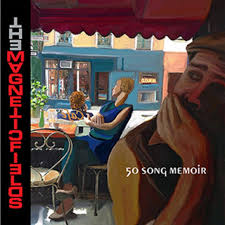
Magnetic Fields – 50-Song Memoir
Tuesday, March 27, 2012
Mar '12 reviews
These reviews ran in the Kitchener-Waterloo Record and Guelph Mercury this month.
The Decemberists – We All Raise Our Voices to the Air: Live Songs 04.11-08.11 (EMI)
What do the Decemberists and Duran Duran have in common? Nothing, until now that they both have live albums that betray every vocal shortcoming of their lead singers. Hearing Simon LeBon whimpering and straining to sing his biggest hits on 1984’s Arena album sealed that band’s fate and marked the end of an era. The Decemberists’ Colin Meloy, although known for having a nasal and somewhat affected delivery, has never come off as a terrible singer on studio recordings. Here, one this pre-hiatus release, his tenuous relationship to pitch is more than distracting, even if the band behind him sounds on top of their game running through their entire discography in front of an adoring crowd.
Meloy’s voice here may be one that only a fan could love—but then again, this entire package (released as the band begins a hiatus) is aimed at fans only. That explains the inclusion of stage banter, in-jokes, and instructions for audience participation. You kind of had to be there. If you weren’t, you’ll wonder why this high-end bootleg is commercially available. (Mar. 22)
Del Bel – Oneiric (Out of Sound)
Picture yourself travelling across the country, from west to east, stunned by the natural beauty during endless daytime drives, and haunted by the neverending sky and all-consuming darkness at night. Del Bel is the the ideal soundtrack for such a journey, a balance of beauty and optimism with eerie, uncertain undertones.
This Toronto band revolves around two Western musicians, Calgary’s Tyler Belluz (Kite Hill, Bry Webb’s band), who wrote and arranged all the music, and Lisa Conway (Mandibles, Owle Bird) from remote northwestern B.C. The music they make together is either a jaunty though somewhat unsettling country shuffle, or full of ominous dread, scraping violins and twangy guitars, all of which could out-spook their friends in Timber Timbre. “How does one fight the dark alone, with no guns and no will to go on?” asks Conway, in a way that suggests she may know the answer, but certainly isn’t going to give anything away to you.
Though Del Bel tap into a Canadian gothic tradition of everyone from Cowboy Junkies to the Silver Hearts and the Sadies, they’re a step above many of their influences and their contemporaries with incredibly delicate and deliberate arrangements: this sounds less like a rock group of friends than a hired orchestra of players, with Conway singing out front and Belluz conducting everyone else behind her. The result is magical, unique, and easily one of the strongest Canadian albums of the last 12 months. (Mar. 22)
Download: “Dusk Light,” “This Unknown,” “Beltone”
Bill Fox – One Thought Revealed (Jar Note Records)
Until last year, Bill Fox was one of those reclusive geniuses with a limited discography and mysterious whereabouts—the kind of geek obsession that inspires Nick Hornby novels (see his latest, and finest, Juliet Naked). Fox was in fact the subject of a much-loved article in The Believer magazine in 2007, where the author tried in vain to find the man who made one of his favourite albums of the ’90s, Shelter From the Smoke. In 2009, that album was reissued and Fox started playing sporadic live shows (in part at the urging of Ottawa’s Jon Bartlett, of Kelp Records).
So now the mystery is just a man, just another guy with a guitar who happens to be releasing his first album in 14 years. Will anyone still care? They should. One Thought Revealed is not just an acoustic singer/songwriter record made by a guy who grew up listening to Bob Dylan and came of age with Robert Pollard of Guided by Voices. Fox makes the most of his limited recording means: the acoustic guitars sound crisp, the organs and keyboards are ghostly and psychedelic, and his own coarse howl is impassioned and intriguing—in part because of his unusual imagery and wordplay. And Fox is nothing if not economical: the 27-minute album has eight songs without a wasted moment between them, rich in both melody and atmosphere.
Welcome back, Bill Fox. Don’t hold out another 14 years. (Mar. 22)
Download: “Whithering Soul,” “Babylonia,” “Moonlight Stragglers on a Lonesome Toe”
A. David MacKinnon – The Past is a Foreign Country (independent)
MacKinnon spent most of the last 12 years co-fronting the Fembots, one of the perennially underrated bands during that transformative time in Canadian music. With that band now on hiatus, MacKinnon’s solo debut isn’t about to change his underdog status: albums full of cinematic instrumentals rarely vault anyone into the limelight. Yet it’s easily one of the best records in his discography. His melodies sing out stronger without his vocals; they’re illustrated fully and effectively in his piano playing and his horn arrangements. Those two elements are at the core of almost every song here, whether the music is a wistful romantic number, a harpsichord-driven tango, or, as in the title track, a 7/4 swing showing traces of Ethiopian jazz scoring a ’70s New York City action flick. Not only is the music evocative; MacKinnon scores some great titles as well. Thanks to him, I googled “Ambrose Small” and “the Sylvan Apartments” and found some fascinating ancient Toronto history. Lots of rock musicians turn to soundtracks after they’re done with pop music, but with an album as good as this one on his resumé, MacKinnon should be accepting Oscars in no time. (Mar. 29)
Download: “The Past is a Foreign Country,” “Clocks Against Typewriters,” “March of the Hydro Towers”
Magnetic Fields – Love at the Bottom of the Sea (Merge)
Blouse – s/t (Captured Tracks)
Songwriter Stephin Merritt has never met an artifice he doesn’t like. His biggest success was a 3CD conceptual project exploring the love song in every possible incarnation, and he’s recently been collaborating on new versions of Chinese operas. The through line in all his work has been a wicked wit and a keen insight that spoke emotional truths underneath the wordplay and winks. For a man committed to arch genre exercises, Merritt could still make grown men cry—as really, any great popsmith should.
Love at the Bottom of the Sea marks the first time in over a decade that the Magnetic Fields has returned to a synth-based approach, much to the delight of his oldest fans. And while there’s no faulting the instrumentation, Merritt’s melodic sense has faded somewhat—even though it was still in full force on the last two Magnetic Fields albums, which were less than well received by the ardent fanbase (and both of which are better than this album).
It’s the lyrics here that really sink Merritt’s ship. With one or two exceptions (including the superb single “Andrew in Drag”), Merritt’s reliance on his rhyming dictionary is no longer clever, it’s juvenile. He’s more concerned with finding out how many words rhyme with mariachi than he is in writing a lyric with any weight—or, for that matter, wit. For one of this generation’s most outstanding songwriters, one whose lesser works have been at least interesting, it’s shocking to see him stumble like this.
Unlike Magnetic Fields, the Portland, Oregon band synth pop band Blouse arrives with zero expectations—and therefore have plenty of room to surprise. They draw heavily from early New Order, mid-period Cure and other staples of John Hughes soundtracks, with nods to more modern incarnations of the same sound, like The XX or their chillwave Portland neighbours Washed Out. While the synths and the icy cooing of singer Charlie Hilton are the focus, the arrangements are far from bloodless, showing off more muscle than you’d expect from this genre of music, even when the synth sounds are bent to sound like broken cassette players. The songwriting is not yet fully realized, and though there are some awkward lyrical moments (“Time machines can be unfortunate when they’re in your hand”), these are growing pains rather than fatal flaws. (Mar. 15)
Download: “Into Black,” “They Always Fly Away,” “Firestarter”
Mike O’Neill – Wild Lines (Zunior)
Since the demise of the beloved ’90s bass-and-drums indie rock duo the Inbreds, Mike O’Neill has kept a very low profile, releasing two solo albums but mostly working in the Halifax film industry—including a recurring role on Trailer Park Boys.
Wild Lines, his first album in eight years, marks a fine return to form: O’Neill always wrote clever, catchy songs, and this is easily his finest collection since the end of the Inbreds. O’Neill is an economical writer; any time he pushes much further past the three-minute mark (which is not often—twice, in fact) he sounds like he’s treading water. He’s nowhere near as quirky a lyricist as he was in the Inbreds, for better and worse. But nor should he be—he’s an older man now, and more likely to write a song about flipping through old family photo albums or teaching children to tidy up than he is to sing about eating a bicycle. The recording is homespun but fully fleshed out, somewhere between the slick 2000 album What Happens Now? and 2004’s lo-fi The Owl; O’Neill’s tender and affecting vocals are at the forefront, layered with Beatlesque harmonies. Well worth an eight-year wait. (Mar. 15)
Download: “Henry,” “Calgary,” “She’s Good”
Joel Plaskett - Scrappy Happiness (Maple)
“A real rock record is like a wrecking ball,” sings Joel Plaskett on this, his seventh solo album. He’s not talking about the new Springsteen album (or an old Emmylou Harris one), but about the galvanizing power of a great rock record, one that changes your life, makes you reimagine your world and the possibilities within.
One wishes that this was just such a record—it’s not. Instead, it’s a record about how much Joel Plaskett loves listening to and making records. Dropping a lyrical reference to Husker Du is one thing; dropping a reference to ’80s prog band Marillion or the ’70s rock band Cactus (which featured Jeff Beck and members of Vanilla Fudge) is a whole other geekfest. At least this time out Plaskett avoids some of the dorky rhymes that threaten to derail some otherwise great songs on his last couple of albums.
Plaskett’s reverence is more than just pastiche; this could be a genuine lost ’70s rock record, recorded live in the studio with an equal mix of warm mandolins and blistering loud electric guitars. Or, for diehard Plaskett fans, it sounds like the finest moments from his two best records: Down at the Khyber and La De Da.
Plaskett is enough of a Canadian institution now that no one expects a sharp left turn, and so if Scrappy Happiness can be faulted for being entirely predictable, it also shows off a master craftsman at work: as a songwriter, as a bandleader, and even as a guitarist (he and sideman Peter Elkas trade hot licks in the closing “Lightning Bolt”).
It’s no wrecking ball, but it’s another solid storey in Plaskett’s tower of song. (Mar. 29)
Download: “Harbour Boys,” “I’m Yours,” “Somewhere Else”
Johnny Reid - Fire It Up (EMI)
Johnny Reid doesn’t sing the blues. Johnny Reid probably wonders why anyone would sing sad songs in the first place. Isn’t music supposed uplift the listener? Shouldn’t you come away from a performance—or even just a song on the radio—feeling reassured, loved, and inspired? Reid may be the last earnest man left in the music business, the kind of guy whose song titles ask rhetorical questions like “What Makes the World Go Around?” (I’ll give you one guess what the answer is. Hint: it’s love.)
Reid continues his move away from country music and into gospel-inflected inspirational rock balladry. It’s inherently cheesy territory, but don’t tell Reid that: he throws his considerable talents as a vocalist behind every line, and you better believe that he’s feeling it. As a songwriter, however, he doesn’t always hit that mark: “Let’s Have a Party” sounds suspiciously close to Bruce Springsteen’s “Mary Place” (from The Rising, an album from which Fire It Up draws obvious inspiration—no Darkness on the Edge of Town here). “Walking On Water” is a duet with Serena Ryder that should be a match made in heaven—their voices are perfectly complementary, both being natural born bluesy belters. It’s a crying shame, then, that the song itself is dismal and riddled with clichés.
Reid is a powerful presence who can milk genuine emotion from the thinnest source material; too bad he’s all too often called on to do just that. (Mar. 29)
Download: “Fire It Up,” “Till We Meet Again,” “Right Where I Belong”
Tindersticks – The Something Rain (Constellation)
Tindersticks are well-dressed men in black who make noir-ish lounge music rich in narrative and ominous atmosphere. (Which explains their appeal to Sopranos’ creator David Chase, who used their music in two key episodes.) They’re good at what they do, and they’ve been doing it fairly consistently for 20 years now—to a fault. If you’ve ever owned one Tindersticks album, you own them all. Until this one.
After a series of lineup changes that stripped the band down to its core, Tindersticks now sound like an almost entirely new outfit, even though all their signature sounds are still there. Singer Stuart Staples is a seductive, compelling crooner, who doesn’t seem bothered by the fact that The National’s Matt Berninger has sold out small stadiums with the same schtick. The soul influence Tindersticks took on in the late ’90s has simmered to a fine essence, giving the rhythm section an extra punch and making the presence of sax solos and bongos less incongruous. Every sonic texture appears to be wrapped in red velvet; every song is set after sundown. No matter the tempo, every track on The Something Rain is sensual and luxurious, lulling the listener into an opiate daze.
Come Inside sounds like Bryan Ferry fronting Pink Floyd circa Dark Side of the Moon (specifically “Us and Them”). “Show Me Everything” could be Nick Cave fronting Air. And yet The Something Rain is such a world unto itself that such comparisons—to other or the band’s own discography—only surface when trying to explain why a new Tindersticks album is worth your time. It’s the most intoxicating album you’ll hear this winter—isn’t that reason enough? (Mar. 15)
Download: “Show Me Everything,” “This Fire of Autumn,” “Medicine”
Caetano Veloso and David Byrne – Live at Carnegie Hall (Nonesuch)
The Talking Heads frontman played a large role in introducing the Brazilian tropicalia legend to North American audiences in the late ’80s. Why this 2004 recording is only coming out now is a mystery, but for fans of either artist it’s a welcome chance to hear them in an acoustic setting. Veloso’s six solo songs are dreamlike and languid; Byrne’s eight-song set is more direct, and obviously the few Talking Heads songs jump out, even if he reinvents them effectively for the setting. But Byrne also doesn’t get enough credit for his songwriting of the last 15 years, which is the real focus of his set here (“She Only Sleeps,” “Everyone’s In Love With You”). The two duet on Byrne’s “Dreamworld” and Veloso’s “Ile Aiye,” which both help make up for the atrocious version of Byrne’s “Nothing But Flowers,” where Veloso camps it up to the point of mocking Byrne’s vocal tics—it might have been funny at the time, but it’s downright painful here. Appropriately enough, the set ends with Veloso’s song “Terra”—written in 1968, about viewing photos of Earth from space—and Byrne’s “Heaven.” (Mar. 29)
Download: “Terra,” “Ile Aiye,” “Everyone’s in Love With You”
Yukon Blonde – Tiger Talk (Dine Alone)
The Shins – Port of Morrow (Sony)
It was over 20 degrees in Ontario on the day in March this album was released. In fact, everything about Yukon Blonde’s second album sounds like summer all year round. Huge four-part harmonies and songs meant to be sung at full volume barrelling down the 101: that’s what this Kamloops, B.C., band excel at, along with a strange affinity for 1982, a time when new wave power pop (think: the Go-Go’s) competed with Southern rock holdovers (think: 38 Special) on the Top 40 charts. Producer Colin Stewart (Black Mountain, Kathryn Calder) gives everything a streamlined radio sheen that sounds huge while never sacrificing warmth and still placing the acoustic guitar front and centre when necessary. The tunes are sharp and sassy, and the occasional dorky lyric is easily forgiven. What would it sound like if Fleet Foxes fronted Sloan? Yukon Blonde are taking that answer all the way to the bank.
The Shins aren’t as rooted in classic rock as the deliciously derivative Yukon Blonde, but songwriter James Mercer is likewise known for writing killer melodies and setting them to a hazy, luxurious West Coast soundscape to decorate his take on indie rock. The 2007 Shins album Wincing the Night Away was their best—and by that point the band had essentially been stripped to being a Mercer solo project. Port of Morrow similarly finds Mercer working with hired guns, including members of Sleater-Kinney and Modest Mouse. Only this time, Mercer’s surefire pop songs are in much shorter supply. He pulls off a quirky ballad or two, and “Simple Song” packs a punch that the rest of the album seriously lacks. Everything else falls through the cracks; at best, Mercer sounds like a mellower, poor man’s version of the New Pornographers’ A.C. Newman. The dreamy production, by Greg Kurstin (Lily Allen, Kylie Minogue, Foster the People) saves this from being a total snoozer, and diehard fans will at least be placated. (Mar. 22)
Download Yukon Blonde: “My Girl,” “Radio,” “Stairway”
Download the Shins: “Simple Song,” “Fall of ’82,” “It’s Only Life”
Tuesday, January 26, 2010
Jan '10 reviews
The following reviews ran in the Kitchener-Waterloo Record and Guelph Mercury.
All Tomorrow’s Parties DVD (ATP/ Sonic Unyon)
All Tomorrow’s Parties is not a concert film; nor is it a documentary. Instead, it’s a series of snapshots of the 10-year-old U.K. music festival, interspersing live footage, candid shots of performers, and more than a few infuriating portraits of stoned British music fans goofing around in the seaside holiday resort where the original ATP festival is held (it has since expanded to put on events in London and in the U.S.).
What’s most fascinating about this countercultural celebration is the eclecticism: ATP takes pride in assembling iconoclasts whose only real common thread is a unique approach to their chosen genre of music—if they’re not already inventing new genres themselves.
And so the film opens with the danceable prog rock of Battles and closes with Grizzly Bear singing a cappella on a beach. In between we see visceral performances by stars and legends such as Portishead, the Yeah Yeah Yeahs, Patti Smith and Iggy Pop with the Stooges, as well as the comparatively unknown like the Balkan folk group A Hawk and a Hacksaw (playing acoustically in an arcade), poet Saul Williams and visceral crowd-pleasers Les Savy Fav. Not everyone is warmly embraced, however; there’s a painful clip of comedian David Cross being booed off the stage.
Cleverly interspersed with the modern doc footage is archival footage of British seaside vacationers from decades past, as well as various psychedelic effects that add to the stream-of-consciousness approach. The whole film functions as a surrealist dreamscape, without any narrative or particular point: just an immersive, ephemeral experience that overloads the senses. Not unlike an ATP weekend itself, no doubt. (K-W Record, January 21)
Boogaloo Pow Pow: Dancefloor Rendez-Vous in Young Nuyorica – Various Artists (Honest Jon’s)
Compared to the comprehensive compilations put out by reissue labels Soundway and Analog Africa, the relatively brief liner notes found inside this collection seem slight, as they attempt to explain the evolution of ’60s and ’70s Hispanic-American (mostly Puerto Rican) music as it morphed from mambo and cha cha cha into boogaloo and shingaling. And the tracks, some of which are licensed from EMI and Universal, are probably not terribly rare.
But who cares? Every track here puts a strut in your step, from the screamin’ hot “Cool Jerk” by Kako, to the insanely tense build-up in Manny Corchado’s “Pow Wow,” to solid tracks by better known artists like Tito Rodriguez, Willie Rosario and Ray Barretto. The horns are blazing, the rhythms are unstoppable, and the whole thing is a party in a can. Other compilations can try and contextualize all they want: on this one, every single track speaks for itself—and it’s commanding you to dance. (K-W Record, January 7)
5 Years of Hyperdub – Various Artists (Hyperdub)
Arguably, the genre that U.K. critics call “dubstep” is just the latest semantic shellgame for the ongoing evolution of electronic music. In this case, it’s dark, often doomy beats that mine everything from Kraftwerk to Jamaican dub reggae to Timbaland’s take on hip-hop, with staggered beats, jittery synthesizers and a sparse, icy sheen best suited to late night chill-outs, no matter the tempo and despite the occasional abrasion.
In what is largely a singles-based scene, Burial and Kode 9 are the two key dubstep artists (actually, the only ones) to have made a mark with full-length albums. And it’s easy to hear why: their tracks here (three from Burial, five from Hyperdub founder Kode 9) leap out from the rest of the pack and display an inventiveness that can easily stretch out to an album’s length. Burial lets snippets of sound slowly sink into the dub mix, building maximum tension as he decides what to reveal from behind the curtain, while subsonic bass and disembodied vocals cast hypnotic spells. Kode 9 constructs soundscapes like the Wu-Tang Clan’s RZA raised on reggae instead of dusty soul records.
Outside of the two principals—and the almost-as-well-known (and that’s entirely relative, of course) Zomby—5 Years of Hyperdub offers mostly diminishing returns. Media hyperbole notwithstanding, dubstep is hardly revolutionary enough to the point where even its lesser lights are fascinating. Of the 15 other artists on this 32-track double CD, only Darkstar, Joker and Black Chow leave any kind of impression. L.A.’s Flying Lotus is the only non-Brit invited, and he sounds like he’s on a whole other trip entirely; meanwhile, The Bug, who predates dubstep, sounds like he dusted off something horribly dated from 10 years ago rather than his far superior new material.
Casual observers would be better off sampling Kode 9 or Burial; the rest is recommended as a time capsule for serious explorers only. (K-W Record, January 14)
Legends of Benin: Afro-Funk, Cavacha, Agbadja, Afro-Beat 1969-1981 – Various Artists (Analog Africa)
Every year there is no shortage of African compilations that hit the market, but only in recent years has this niche market taken off: thanks in large part to two record labels, Soundway in the U.K. and Germany’s Analog Africa. You can’t go wrong with anything in their collective catalogues, but of the hundreds of dollars I’ve spent on their albums in the last couple of years, one album stands heads and shoulders above the rest: Legends of Benin.
On the surface, Legends of Benin has what every great African comp has: a mix of Afrobeat, American funk, Latin rhythms and jazz. But the four artists focused on here— Gnonnas Pedro, El Rego, Honoré Avolonto and Antoine Dougbé—share an entrancing aesthetic that sheds busier arrangements and leaves plenty of sonic space for deep bass lines, owing more than a bit to not just James Brown but Jamaican reggae, even if only one track here draws any direct reggae influence (Avolonto’s “Tin Lon Non”). Each man is a compelling vocalist, whether they’re screaming over furious funk or crooning over languid guitar rhythms.
Though this all may appear par for the course, compiler Samy Ben Redjeb has hit the goldmine with these four men, as every single track here is nothing short of mindblowing, from the opening dancefloor killer of “Dadje Von O Von Non” to the haunting closing lament of “La Musica en Verité,” both by Gnonnas Pedro. Sure, these compilations are pricy, but know that a), Redjeb goes to great trouble to track down the artists and compensate them or their families accordingly (as detailed in his fascinating travelogue liner notes), and b), it’s worth every hard-earned cent. (K-W Record, January 7)
Magnetic Fields – Realism (Nonesuch/Warner)
The sincerity of songwriter Stephin Merritt is often questioned; and in return, Merritt questions why we demand sincerity and earnestness from our songwriters—especially those with acoustic guitars. When the Magnetic Fields use synths or hazy waves of distorted guitars, it’s easier for listeners to appreciate the hilarious narratives and rhyme schemes that Merritt employs regularly, even though there is often serious heartbreak and pathos in those same songs.
And so here, on an album where the instrumentation is entirely pre-rock’n’roll era—and which actually features a song called "We’re Having a Hootenanny Now"—Merritt continues to balance what can be dismissed as novelty songs with more serious fare. More often than not he attempts both at the same time, employing witty wordplay to illustrate emotional complexity, which is Merritt’s specialty.
Musically, Merritt defines Realism with ukuleles, mandolins, toy pianos and cello countermelodies colouring all the songs here; synths and drums are verboten, and electric guitars are rare. Shirley Simms and pianist/percussionist Claudia Gonson share vocals with Merritt, recalling the Magnetic Fields’ defining work, 1999’s 69 Love Songs.
Indeed, much of Realism sounds vaguely familiar: several tracks sound like they could have been culled from various other albums in the Merritt discography. Longtime fans might wish Merritt would take his own advice from one of the songs here: “Do something out of character/ anything/ do something true.”
And yet, being the master craftsman that he is, it doesn’t at all sound like he’s stuck in a rut; each song stands with his best, making it an ideal entry point for anyone unfamiliar with his massive body of work.
That said, if you find the idea of a man chorus singing a verse in German on a song called “Everything is One Big Christmas Tree” to be more nauseous than novelty (or, more accurately, a comment on consumerism plastic smiles), then Merritt’s Magnetic Fields are a taste you’re unlikely to acquire. (K-W Record, January 28)
Olatunji! – Drums of Passion (Sony Legacy Edition)
This Nigerian percussionist is credited with bringing African drumming to the American mainstream—influencing John Coltrane, Carlos Santana and the Grateful Dead, and leading to performances at Kennedy’s inauguration and at key Martin Luther King Jr. rallies. This 50th anniversary re-issue offers ample reasons why, with a gorgeous remastering job, informative booklet, bonus tracks and the 1966 follow-up More Drums of Passion as a bonus disc. The latter, recorded by Miles Davis’s producer Teo Macero, is arguably even more fascinating, more frenetic and more accomplished.
Sure, there are more than a few moments that make you feel like you’re trapped at a folk festival drum circle—until you realize that not only is Olatunji a true master, but this is the album that changed the way North Americans thought about music. The percussive onslaught is impeccably arranged and augmented by gorgeous choral chants (think: Gainsbourg’s “Couleur Café”) and, on the bonus tracks, some jazz instrumentation as well, which works perfectly and is a welcome change of scenery.
Sony’s Legacy Edition imprint is one of the only major labels to do loving reissues properly, and though this isn’t likely to be one of their bigger sellers, it’s treated with appropriate reverence. (K-W Record, January 7)
Panama 2: Latin Sounds, Cumbia Tropical & Calypso Funk on the Isthmus 1967-77 – Various Artists (Soundway)
Panama 3: Calypso Panameno, Guajira Jazz & Cumbia Tipica on the Isthmus 1960-1975 – Various Artists (Soundway)
The most fascinating reissues of recent years have focused on cross-cultural clashes: Ethiopiques, Cambodia Rocks, many of the Sublime Frequencies releases, etc.
In a geographical centre like Panama, however, anything and everything goes: there is plenty of American jazz with Latin rhythms—as had already been popular in the U.S. for at least 20 years by the time these recordings were made—but also heavy influences from the Caribbean and Colombia, and similar strains heard in Afro-funk, to say nothing of the subtle influences from the diverse group of international migrant workers that were brought to Panama to finish the canal in the early 20th century.
And so here we have Latin jazz, R&B, calypso, salsa, merengue and even some raw garage rock guitars. Peculiar to these compilations is the Panamanian style of tipica, which is related to the slow Colombian cumbia, though often featuring accordion and sharper percussion. Compiler Roberto Ernesto Gyemant goes to great detail in his engaging lead essay for both compilations, as well as with notes on individual tracks.
Not only does Gyemant know where to find the quality rarities, he knows how to sequence them. Both comps move effortlessly from sparse calypso to raging big band jazz to percussion-heavy tracks like Ceferino Nieto’s “El Pajaro Zum Zum,” which features a monstrous drum break that’s bound to end up in a killer hip-hop track before the year’s end—in fact, nothing else seems to happen in the song, except huge drums, subtle bass, and Nieto screaming in incomprehensible English like James Brown with an itch he can’t scratch.
For a breather, there is the slow, deep funk of Los Silvertones’ “Carmen,” with its Funkadelic guitars and Ethiopian-sounding saxophones, or the slinky groove of the Duncan Brothers’ “Dreams,” or the lilting reggae of Sir Jablonsky’s “Juck Juck.”
Only a few artists appear more than once; it’s not hard to fall in love with the calypso crooner Lord Cobra or the psychedelic sounds of Los Silvertones. But even amidst the wealth of artists heard here, there’s shockingly little repetition stylistically, which means neither of these compilations ever wear out their welcome. (K-W Record, January 21)
Yoko Ono Plastic Ono Band – Between My Head and the Sky (Chimera)
It shouldn’t surprise anyone who’s ever heard any of her music that Yoko Ono, at age 66, is still wonderfully weird. Certainly, there are placid moments and musing on mortality on her latest album. But right from the opening track, “Waiting for the D Train,” she’s wailing and cackling over garage rock guitars and post-punk dance grooves—showing the likes of Karen O who’s still the boss.
For all the ridiculing she’s endured over the decades, she’s been largely vindicated by new generations of musicians who try to push the envelope in ways they later discover Ono was doing 35 years ago. And so Between My Head and the Sky is a victory lap for her, as she leads a funky band helmed by her son Sean and Japanese electronic artist Cornelius, and continues to use her voice in ways precious few singers do (for better or worse). The only serious pitfalls are the more maudlin pleas for peace on tracks like “Healing,” which haven’t grown any more complex since the naïve absurdity of the bed-ins.
Ono’s timing is perfect: not because of the much-ballyhooed Beatles reissues of 2009, but because people like the Flaming Lips, Bjork and other freaks have crept closer to the mainstream, and combined with the strength of this album, it’s the perfect time for skeptics to take a second look. (K-W Record, January 28)
RJD2 – The Colosuss (Electrical Connections)
There was a time when a DJ album meant certain things: sampling, scratching, hip-hop beats, techno. These days, however, a DJ is expected to be more eclectic, both in the club and on CD. RJD2 has expanded beyond the cinematic hip-hop that defined his earlier work—the kind that attracted the producers of TV’s Mad Men, who picked one of his tracks as their theme song—and made a diverse pop album that includes everything from harpsichord funk (“Giant Squid”) to spy movie themes (“The Stranger,” “Small Plans”) to ’80s R&B and swinging ’60s pop (“Walk With Me”).
Musically, he pulls it off with aplomb—he’s slowly been moving from an entirely sample-based artist to a multi-instrumentalist. It’s the tracks with vocals that stop The Colossus from greatness: not that the singing is bad, either by RJD2 himself or guest vocalists, but he hasn’t really figured out how to work with a vocal melody yet—because until now, he’s successfully focused on letting the music do all the talking. Ironically, this would be a better pop album if it didn’t have any vocalists on it. (K-W Record, January 28)
Spoon – Transference (Merge)
Few rock bands take minimalism to the max the way Spoon do, stripping away all excess fat and focusing on the bare essentials. It’s an approach that worked to brilliant effect on their 2002 breakthrough Kill the Moonlight, which took an approach almost akin to dub reggae, in terms of what instruments would suddenly drop out of the mix and when.
After two slightly more conventional—and increasingly popular—albums, Spoon have now pulled everything back again to make the sparsest album of their career. Unfortunately, it doesn’t work as well this time. Far too many songs find the entire band chugging away on the same quarter note, in a fashion more suited to demos than a finished product. It could be that this is their point: leaving so many blank spaces to let the listener project whatever they want between the lines. Or it could be just lazy.
This being Spoon, however, all is not lost. Five of the album’s 11 tracks show signs of former brilliance (“Mystery Zone,” the 2009 single “Got Nuffin”); “Who Makes Your Money” is a trippy take on opiated R&B; closing track “Nobody Gets Me But You” channels early-’80s Prince and the minimalist funk of ESG. “Goodnight Laura” is an uncharacteristically straightforward piano ballad.
Those are the only songs where it sounds like they’re actually trying; too much of Transference sounds like they just gave up. (K-W Record, January 21)
Vampire Weekend – Contra (XL)
For whatever reason, this young band’s debut album proved to be remarkably divisive. For every fan won over by their innocent charm and breezy songwriting, they faced a nasty detractor put off by their preppy ways.
Contra is bound to meet the same fate, as Vampire Weekend unspool some of their arrangements to explore different textures, and use the studio more creatively than merely capturing their live sound and adding a string section. Here, they appear to have been listening to New Order, ska, soca, and surf rock, all of which collide with varying degrees of success. Multi-instrumentalist whiz Rostam Batmanglij has no shortage of inventive ideas, but deciding to let vocalist Ezra Koenig use Autotune on the dreadful “California English” was not one of them.
If Batmanglij is the band’s secret weapon, Koenig is their not-so-secret albatross. His lyrics, which at best are cute and clever, are mostly cloying and clunky on much on Contra—no more so than on the horrific closing track, “I Think UR a Contra,” which may or may not have something to do with a couple comparing their communication with right-wing Nicaraguan rebels of the ’80s. Or whatever. The listener’s first warning is when Koenig leads off the album with the couplet: “In December, drinking horchata/ I look psychotic in a balaclava.”
Maybe the South African township jive they love so much has equally inane lyrics—who knows? For English speakers, Koenig is largely a dippy distraction from an otherwise interesting band, one that shows signs of successfully dodging a sophomore slump. (K-W Record, January 14)
Hawksley Workman – Meat (Isadora)
The last time we heard from this prolific performer, he had released an album with the ridiculous title Los Manlicious, where he tapped into the swagger that has defined his most sublime moments. That swagger is still there, and Workman is indulging some of his wilder urges on tracks like “(We Ain’t No) Vampire Bats,” while still allowing room for intimate moments like the piano ballad “Song for Sarah Jane” and the anthemic R&B slow jam “The Ground We Stand On.”
But if the performances and the production bring out the best in him, aside from the aforementioned standouts Workman’s songwriting doesn’t measure up. The lyrics are as whimsical as always, and you’ll either love or hate his odes to baby mosquitoes, Tokyo bicycles, and French girls in L.A.
The problem is that none of the tunes demand the enthusiasm that he creates in the studio for them; maybe they’ll come across better live. If not, fans won’t have to wait long for his next album, Milk: the single, “We Dance to Yesterday,” is already out and the album is due in the spring. (K-W Record, January 28)
Sunday, August 02, 2009
Merge XX OO
But there’s something much more special about an event that only takes place every five years, in a small town, curated by a boutique indie label that feels like family.
And so it was that my ladyfriend and I headed to Chapel Hill, North Carolina last week to celebrate Merge Records’ 20th anniversary. We had myriad personal reasons to embark on the journey as well—which, truth be told, were probably the main push that brought us there. We’re both fans of the Merge roster, but there didn’t seem to be a lot on the line-up that we hadn’t seen many times before; the main musical attraction was the Magnetic Fields, who rarely tour and who have soundtracked our lives—together and apart—since the release of 69 Love Songs 10 years ago.
There was a part of me that wondered if this would be a swan song for my indie rock past. I have little nostalgia for much of anything from the ’90s, a decade that for the most part sounds like one long wasted creative opportunity. I rarely, if ever, get excited about guitar rock bands anymore. My tolerance for standing inside black-walled clubs for hours on end is at an all-time low. And although their curatorial history is largely impeccable, I found 2008 to be a consistently disappointing year for Merge releases.
So why did I end up having the best musical vacation of my life at Mergefest?
For starters: the people. The staff at Merge—past and present—are, to a person, warm, engaging, entertaining, and fanatical music geeks. They remember your name and face even if you’ve only seen them for a grand total of five minutes in the past five years. And then there are the fans, the ringleader of which is “Crazy” Tony Susco from Jersey City. He MC’ed the Saturday night proceedings, and organized the Friday afternoon kickball game that introduced strangers from all corners of the continent, who became fast friends over the course of the weekend at various dinners and day trips to swimming holes.
Secondly: the locale. From Toronto, Chapel Hill is definitely worth a leisurely drive through the Blue Ridge Mountains with a camping stop along the way. The town reminds me a lot of Guelph or any other quaint university small town with nearly every amenity you would want from a major city (and Raleigh-Durham is a 20-min drive away). The food was uniformly excellent. And most importantly for an event like this, the Cat’s Cradle club holds a lot of people comfortably, with good sight lines from anywhere, a back patio to escape to, and consistently excellent sound. If you’re going to be stuck in a club all week, this is the one to be in. (Hats off to the remarkably efficient stage crew, as well.)
To the music: Each night was a surprise. The organizers purposely kept the schedule a secret, in part to ensure excitement for each slot. This was occasionally frustrating—is our dinner going to run late and we’ll miss Favourite Band X in the opening 7 p.m. slot? It also dangled the idea of additional, unannounced surprises—which was ultimately a big tease, especially for the trainspotters who were somehow convinced that Neutral Milk Hotel or Arcade Fire or Dinosaur Jr. would show up. I think I was the only one crossing his fingers for the first-ever show by the reclusive East River Pipe. (Not entirely improbable: Fred Curnog was there all weekend with his wife and daughter, smiling and hugging everyone and enjoying the shows. One of my weekend regrets was finding this out too late to meet him myself.)
Friday night opened with what had been promised would be a can’t-miss affair—which it was for locals who remember the band Pure, who hadn’t played together in something like 18 years. Even Merge didn’t know what had happened to them in the interim, until the drummer showed up at a Portastatic show in Asheville last year. Pure were the first of many reunions—most of which meant far more to the locals than to the tourists like me.
Pure were followed by Lou Barlow, who was a new Merge signing when he opened the 15th anniversary shows five years ago; at that show, he was opening for a band no one had heard of called the Arcade Fire. His 2004 album Emoh holds up remarkably well; he has a new one due in the fall. Yet through his set and the subsequent show by Oakley Hall, I was regretting the fact that I was missing Eric Bachmann of Crooked Fingers—one of my favourite songwriters ever, and whose Forfeit/Fortune album of 2008 has been in constant rotation in our house since its release. He was playing an early solo show in Durham entirely unrelated to the festival; I could easily have seen that and caught the last three acts at Cat’s Cradle, as one local did. Why he wasn’t at Mergefest is anyone’s guess, just as it’s a mystery as to why he voluntarily chose to self-release Forfeit/Fortune, his finest album.
The Clientele is a band I didn’t have the time of day for until I saw them at Mergefest five years ago, playing on the Sunday night of the festival in the beautiful Carolina Theatre opening for Lambchop. There, their wispy British dreampop was a cool breeze after a week of sweaty rock’n’roll. Here, they helped open the week with music that ultimately sounds best when you’re on vacation and your mind has time to wander; I’ve seen them in Toronto and I’ve heard their records, but nothing compares to seeing them in Carolina. They too have a new album due in the fall.
Hanging out on the back deck between sets meant that you often walked back in the club with no idea if anyone had started playing or not—and no idea who it might be. So when I strolled in to see the Magnetic Fields on stage in mid-song, I may have exclaimed “holy fucking shit” a bit too loudly for the hushed, reverent tone of the room. Vocalist Shirley Simms was on board to sing the songs from the 2008 album Distortion (played entirely without distortion—this was an all-acoustic set, with Stephin Merritt on some kind of mandocello, Sam Davol on acoustic guitar, John Woo on cello and Claudia Gonson on a real piano) as well as her share of the 69 Love Songs. It was as magical and marvelous as I could have imagined, and for the first time since seeing Leonard Cohen last year, I was weeping openly at a show—and I was definitely not the only one. The only song not from the aforementioned albums was “Give Me Back My Dreams” by the 6ths (originally sung by Sally Timms); sadly, Lou Barlow didn’t perform “In the City in the Rain,” the song he recorded with the 6ths. During “Come Back From San Francisco,” Claudia leapt up from her piano mid-song, clearly alarmed by some critter that then crawled behind John. What the audience couldn’t see was a six-inch flying cockroach (the Southern euphemism is “palmetto,” apparently) making its way around the stage, cracking up the entire band, who nonetheless managed to finish the song by only slightly butchering the coda. Of course, it’s hard to imagine a more forgiving crowd.
The Rosebuds had the challenge of following up the most sublime moment of the weekend—and as a result, I can’t remember a single thing about their set, other than that I heard my two favourite songs from Night of the Fireflies. Conor Oberst and his Mystic Valley Band then put on a marathon set at the end of an already-marathon evening. Despite the awesome intensity of his band—the kind of players who sound like they practice together for eight hours a day before the gig—I remain mostly indifferent to Oberst’s charms, and not for any of the usual playa-hater reasons. He does, however, earn my respect for insisting on wearing a ridiculously large black sombrero that he would reinstate after every guitar change.
Thursday began by meeting Claudia Gonson in the parking lot of the Cat’s Cradle, and telling her how much the set meant to me, and that the Magnetic Fields were the one band I was looking forward to the most all weekend. “Oh, well, sorry for wrecking the rest of your weekend!” she replied. The rest of the Magnetic Fields had split, but Gonson was very present all weekend, happily chatting with anyone and everyone, posing for pictures, jumping up and down for her favourite bands, organizing swimming excursions, and getting all Merge artists and staff to sign her copy of Our Noise, the new oral history of Merge, like it was a high school yearbook. I spent the rest of the weekend wishing that she had gone to my high school.
One of my companions for the weekend had to miss Thursday night due to a prior engagement; she didn’t miss that much. The Broken West opened the night with a solid set that made me want to revisit their records; they also covered a song from the Teenage Fanclub album that Merge put out. Sadly, few other bands made similar gestures; apparently Spoon has covered Destroyer’s “It’s Gonna Take an Airplane” in the past, but they wouldn’t this weekend.
Richard Buckner sounded exactly the same as he did when I last saw him five years ago, with each dirgey number bleeding into the next with minimal melodic differentiation. I’ve never been a fan; this didn’t change my mind. I had no prior opinion of Guv’ner, another one of the weekend’s reunions, but it was painfully apparent to everyone that they had barely practiced—perhaps not even picked up an instrument—since their last gig ten years ago, when ’90s amateurism was going out of style. Versus also seem stuck in the ’90s, and not in a bad way—just not in a way that sounds remotely interesting anymore; they were a time capsule, and sounded suitably frozen.
So when New Zealand’s 3Ds took the stage and announced that this was their first gig in 18 years, my expectations sank. (It didn’t help that I only knew one of their songs, “Beautiful Things.”) The band themselves seemed befuddled that anyone still cared at all, never mind a packed club on the other side of their world. And yet this was one reunion that clicked; even at its sloppiest, they still had the kind of chemistry that’s impossible to acquire or enforce.
That set the stage for Superchunk, the reason for the season. Merge’s flagship band has been largely silent for the past six years, with only occasional area appearances distracting them from their families, their jobs as Merge executives, or, in the case of drummer Jon Wurster, an extremely busy session career. I’ve seen this band several times over the past 15 years, and have never been disappointed—except possibly when they were touring my favourite album of their’s, 2001’s Here’s to Shutting Up, which found them introducing more acoustic guitars and keyboards while the dwindling audience that came to see them in Toronto mostly wanted them to sound like it was 1993 again. So maybe it’s best that they’ve been laying low, because shows like this prove that these four musicians are in absolutely no danger of losing their edge—just in case that’s something people actually care about. They were on fire from the first notes, each one of them incredibly animated and invigorated, and the set list spanned their entire discography (including early manifestos “Slack Motherfucker” and “Cool”), slowing down only for “Like a Fool,” which was no less intense than the rest of the set. For many people there, this was a weekend highlight; for me it was as good as Superchunk always is; maybe I just take it for granted that they’re such a phenomenal live band.
Friday opened with the Essex Green, who I missed because we were dining with new friends we met at the afternoon’s kickball game. They were followed by Yet Another Reunion, this one being the (aptly-named?) Spent; much like Versus, this sounded fine, but it was a part of the ’90s I’m happy to leave behind.
Unlike most people there, I had few expectations of Lambchop, the much-revered Nashville orchestra that has probably put out more records on Merge than anyone else on the roster. I enjoy two of their albums (Thriller, Nixon); the rest do nothing for me, in some cases even less than that. I saw them put on a somnambulant set here five years ago, the highlight of which was the between-set banter between singer Kurt Wagner and pianist Tony Crow. Here, however, they executed a carefully paced set that began with the delicacy they’ve built their career on and slowly ramped up into the R&B and soul excursions heard on Nixon, which inspired some bona fide disco dancing on the floor. From there, however, the intensity continued to be ratcheted up to full-on techno territory, with all 12 members devoted to a pulsing groove that wound up Wagner to the point where he finally abandoned his seated position and started to get seriously unhinged, climaxing in a verse of Talking Heads’ “Once in a Lifetime” that took everyone in the room right over the top. Lambchop are a band that doesn’t tour; their hardcore fans are spread few and far between. Seeing them have a packed club in their clenches like they did here is hard to imagine anywhere else; this was an extremely rare treat, and it was the unanimous highlight of the entire weekend.
The only way to follow that was for something completely different. Ladies and gentlemen, Polvo. Revered as gods at home both in North Carolina and far afield, Polvo are a big deal to a lot of people. (Dan Bejar: “I got in a taxi at the airport and told the cabbie, ‘I’ll give you $100 if I get to see the last 10 minutes of the Polvo show.’ ”) Those people enjoyed this show. I couldn’t care less, and unlike with Lambchop, there was to be no conversion.
So still coming down from Lambchop, expectations were again lowered for Pipe, a local Punk Rock BandTM on the reunion train. Except that Pipe is everything you want a Punk Rock BandTM to be: ferocious, fowl, snarling, soaring and soaked in beer cans that the audience has pelted them with. These were not creepy old men trying to relive their youth; they could happily kick the ass of ten dozen bands half their age. Score one for the local team.
Spoon were the closers on Friday, and studiously avoided their “hits” in favour of newer material and songs from their first Merge release, Girls Can Tell. Spoon’s popularity may be growing—their last album debuted in the Top 10 in the U.S. and Canada—but this set found them getting pointier and more peculiar, with increased use of Echoplex, dub drops and sharp guitar parts. Spoon were the only act of the whole weekend who draw any serious influences from soul music (Lambchop’s twisted take notwithstanding), and while that went a long way to loosen up the dance floor (especially after Polvo and Pipe), there was still a detachment present that garnered a noticeably subdued reaction for a band that is Merge’s second-most-popular active group. People lost their shit for Lambchop and Pipe; people seemed to merely appreciate Spoon. Perhaps there was no more shit left to lose.
Saturday afternoon was an outdoor show under a tent in the parking lot of the Orange County Social Club, the go-to bar for all pre- and post-show activities. Various commitments caused me to miss nearly all of this, except for the Radar Brothers and an encore set by the 3Ds, both of which went down fine with sno-cone mojitos and mint juleps on this blazing hot day. That meant missing The Music Tapes (one of the only non-guitar bands present, sadly), Portastatic (whose “Noisy Night” always conjures Carolinian memories), Matt Suggs (whose last album, as part of the band White Whale, is one of the most underrated Merge releases—go find it right now!), and Tenement Halls.
Other than the Magnetic Fields, the one act I was most looking forward to seeing was Telekinesis, Merge’s newest signing—if only because I had seen most everyone else before, and Telekinesis’s self-titled debut is the best power pop album I’ve heard since the New Pornographers’ Twin Cinema. The album is the work of drummer/songwriter/singer Michael Benjamin Lerner; he does have a touring band, but a series of family emergencies and calamities caused them to cancel on him for the weekend. So he called up Nada Surf guitarist Matthew Caws and the Rosebuds’ Ivan Howard on bass; they practiced once, three hours before their gig opening up the Saturday night show. You’d never know anything was amiss; they’re all pros, and Lerner’s songs would stand up to any treatment. Lerner probably isn’t much older than the label itself, but you can bet that he’ll be a big part of the next 20 years.
Erectus Monotone: sweet Jesus, are the ’90s reunions over yet? And does Ladybug Transistor count? Because I haven’t even thought about them since they played this festival five years ago.
Which brings us to M. Ward, who apparently insisted that he not close Saturday night, perhaps because he was playing again on Sunday with She & Him. I’ve been a casual fan of his since I first saw him in San Francisco seven years ago; he’s an amazing guitarist and singer, a great producer and a decent songwriter. My only complaint is that I find his songs and albums interchangeable; I rarely reach for them. I’ve seen him solo and with various bands over the years, but his current line-up is by far the best configuration for his live show. They bring out the old-timey rock’n’roll in him, right down to the covers of Chuck Berry’s “Roll Over Beethoven” and the occasion-appropriate Beatles’ “Birthday.” Ward seems to be having more fun on stage than ever; this set was much more joyous than any of his recordings would ever suggest.
Joy is not something one would normally associate with a Destroyer set, but Dan Bejar seemed to actually be enjoying himself. Maybe it’s Mergefest itself; my favourite Destroyer show was his performance here five years ago, with a back-up band of Merge staffers dubbed “The Treacherous Fops” who picked the set list. This time he played solo—not an easy feat after M. Ward’s barn-burning set—and played songs from nearly every Destroyer release, reaching back to “Streets of Fire” from the debut (later covered by the New Pornographers). The newer songs held up well in the absence of his backing band, on whose arrangements much of his recent records have relied heavily. Bejar pondered requests and happily engaged in some mutual heckling with the enraptured crowd—much like with the Lambchop show, it’s hard to imagine an audience that was as totally geeked out as this one. As a huge fan who was ready to give up on Bejar a couple of years ago, this set won me back. Maybe all it took was the occasional smile from the stage.
That left Imperial Teen… and the notion that there was still going to be some surprise act. Most delusional overheard comment: “I heard that Imperial Teen were never supposed to play and their name was only a placeholder for the super secret surprise.” Yeeeee-ah. Right. So facing that kind of implausible expectation, sure, Imperial Teen might have been a bit of a letdown. And sure, they’re not the greatest band in the world. But they’re a fun party band, and they managed to rouse most of the audience who wasn’t still crying over the fact that they’d spent the past week dreaming the impossible dream of a Neutral Milk Hotel reunion. Get over it, people! And dance!
Sunday night we finally got to leave the Cat’s Cradle for the considerably more upscale Memorial Hall on the leafy University of North Carolina campus. Opening the show was another new Merge signing, Baltimore duo Wye Oak, whose new album, The Knot, is so unbelievably superior to their passable debut that I barely believe it’s the same band. Jenn Wasner is a haunting vocalist and occasionally raging guitarist; drummer/keyboardist Andy Stack does all sorts of on-stage juggling to complement her many-changing moods. Sadly, backing vocals are not one of his live duties, and nor are any of the violins and pedal steel heard intermittently on The Knot. But those are minor quibbles, and I’d love to hear this band in a club; the cavernous acoustics of Memorial Hall are not cut out for rock bands, even ones as sparse as this one.
They are, however, ideal for American Music Club. I had no idea what to expect from this set; I knew songwriter Mark Eitzel’s towering reputation among many critics, and I knew that I’d heard him occasionally over the years and nothing every really stuck. So I was a bit shocked, to say the least, to see a dumpy guy in a trucker hat accompanied only by a pianist and singing like Tony Bennett—with all the vocal reach and mic control that reference implies. Eitzel is a storyteller first and foremost, both between songs and in his lyrics, and while I still doubt I’ll buy one of his albums, I would go see him again in an instant. He’s an amazing and unique showman who is alternately heartbreaking and hilarious; I can’t even begin to contemplate a comparison point.
She & Him are anything but unique; singer Zooey Deschanel writes songs that fit perfectly into early ’70s Laurel Canyon pop ala Carole King and Linda Ronstadt. Nothing wrong with that—after all, Telekinesis and M. Ward are just as derivative—but after a weekend of unique and iconoclastic performers like Lambchop, Destroyer and the Magnetic Fields, it certainly seemed the wrong note to close on. And this was definitely a more mainstream crowd than that at the Cat’s Cradle; even before she sang her first note, the first dude of many piped up, “We love you, Zooey!”
I like the She & Him album well enough; I couldn’t care less that Deschanel is an actress first and a singer/songwriter second. Live, however, she is simply unbearable: cutesy, cloying, bouncy, and seemingly without any knowledge of how to sing into a microphone properly—which is key when you have a chirpy voice like she does. (After witnessing Mark Eitzel, this was a particularly egregious crime.) To make it worse, her stage banter was cringey—perhaps because it wasn’t scripted. I felt bad for the band, including M. Ward, not only because they were mere window dressing for the Zooey show, but because the acoustics smothered the set in rumbling bass.
And then came the covers. Deschanel and Ward do a fine acoustic version of Smokey Robinson’s “You Really Got a Hold On Me,” mostly because she sounds far better when she’s singing harmony than lead. But tackling Sam Cooke was considerably trickier; attempting Joni Mitchell was a trainwreck (“You Turn Me On I’m a Radio”). As her piece de resistance, she actually had the chutzpah to blurt her way through Screamin’ Jay Hawkins’ “I Put a Spell on You”—I cannot begin to enumerate the reasons why this was such a horrible, horrible idea.
There were many jaded indie rockers in the audience who don’t like sickly sweet pop music of this vintage variety in the first place—but I do, which made this show hurt even more. Where’s Camera Obscura when you need them? Needless to say, there was some extremely spirited lobby conversation afterwards.
Not that any of that could stain the memories of the past week. Mergefest is one of the only rock festivals with the down-home intimacy of a folk festival (next weekend’s Wolfe Island Music Festival, outside of Kingston, is another), due in large part to the Merge ethos itself: open ears, open minds, sustainable scale, earthbound expectations.
They inspire a loyalty that few other labels maintain, both to and from their artists; and naturally, that trust extends to the mutual relationship with the label’s fans, who gather once every five years for what more than one person called an “indie rock fantasy summer camp.”
A thousand thank yous to all the Merge staff, as well as everyone else who made this trip so amazing: Martin Hall, the Orange County Social Club, Carl “I don’t want to use the phrase ‘genre exercise’ before nine in the morning” Wilson, Wendy Spitzer, Jay Cartwright, Tony Susco, Autumn Cannella, Django Haskins, Jessica from Asheville, Margaret from Orlando, Craig and Rosa from San Francisco, Saleen from NYC, Todd from D.C., Kirk from Lumberton, Mary Catherine from Seattle, Ky from Boston, Carl from Top Drawer Records in Seattle, Bob the Tragically Hip fan from Seattle, Matt from the Dead Mechanicals in Baltimore, and everyone else I encountered there. And to the lovely Helen Spitzer, who five years ago first talked me into doing this—and so many more wonderful things ever since.