Showing posts with label Spoon. Show all posts

Friday, March 31, 2017

Old 97s and Spoon

It's been a really good musical month for 45-year-old, hip Texan dudes.


Old 97s – Graveyard Whistling (ATO)


By the usual rules of rock’n’roll, the Old 97s should no longer exist—never mind be releasing some of the best music of their career. The Texas quartet boasts the same lineup they’ve had since forming in 1993. They’ve been on major labels, indie labels, and everything in between. The singer and principal songwriter, Rhett Miller, has a solo career and yet keeps returning to his old bandmates. His lyrics detail excess that, if true, and combined with the band’s rigorous tour schedule, should have dried up his creativity at least a decade ago.


Yet here are the Old 97s, in their mid-40s, on their 11th album, still full of the piss and vinegar that defined their approach to so-called alt-country since day one. Miller’s sardonic songwriting (“Jesus loves you more than I do / just because he doesn’t know you like I do”) is still several steps above his peers of any age, whether he’s still singing about small-town dreamers who want to “put the past in the rear-view mirror” (“I Don’t Want to Die in This Town”) or whether he’s an older man taking stock of his life and deciding that “all I know is I’m good with God / I wonder how she feels about me.” (To which God, in the voice of co-writer Brandi Carlile, sings back to him: “You should be scared / I’m not so nice.”) Even when he slips into cliché (“Irish Whiskey, Pretty Girls”), Miller’s one-liners are still better than most.


The band behind him roars with energy harnessed from their raucous live shows, yet always leaving plenty of breathing room, perhaps influenced by the remote West Texas town where the album was recorded: more country than punk, with a pronounced spaghetti-Western sound on several tracks.


What a drag it is getting old? Not with the Old 97s. (March 2)


Stream: “Good with God” (with Brandi Carlile), “She Hates Everyone,” “I Don’t Want to Die in This Town”


 Spoon – Hot Thoughts (Matador)


Ever since 2002’s Kill the Moonlight (or 2001’s Girls Can Tell, if you’re a super music nerd), Spoon has been the kind of band that appeals to rock fans who have lost faith in the genre: grumpy old new wave moms and dads or disgruntled indie kids tired of emo whining. Spoon had swagger and mystery; Spoon made records with nary a stray note, minimalist rock’n’roll with an experimental edge with catchy songs always at the core.


After the breakthrough commercial success of 2007’s Ga Ga Ga Ga Ga, which cracked the Top 10, the band lost their way a bit: 2010’s Transference veered too far toward the experimental for most fans, while 2014’s They Want My Soul was catchy enough but sounded like Spoon spinning their wheels. That last album teamed them up with Dave Fridmann (Flaming Lips, Low), who didn’t impose his usual production tricks on a band who didn’t need them—drummer Jim Eno is an acclaimed producer in his own right, so it wasn’t even clear why they’d hire Fridmann in the first place.


But Fridmann is back for Hot Thoughts—and so is Spoon’s creative spark. This is the most successful mix of their experimental and pop tendencies since Kill the Moonlight, and Fridmann brings it into brilliant focus with sonic touches that illuminate all the band’s strengths. Jim Eno’s rhythms are a driving force, even if (or especially when) a set of shakers is placed higher in the mix than his actual drum kit at times. Singer/guitarist Britt Daniel has said the death of Prince hit the band hard while recording; maybe it’s a coincidence, but this is also the sexiest Spoon record in a long while, thanks to Eno’s beats, Daniel’s rhythm guitar and the ear candy from Fridmann and new keyboardist Alex Fischel. (“Can I Sit Next to You” is the kind of killer groove with a song behind it that 2005’s “I Turn My Camera On” wanted to be but didn’t completely pull off.)


The influences of Jamaican dub and electronic music have always percolated in the background of Spoon records; here, they’re far closer to the forefront (see also: King Cobb Steelie, a band it’s safe to say Spoon has never heard); there’s also no acoustic guitar here, for the first time in Spoon’s history. The moments on Hot Thoughts that veer closest to straight-up rock music are filled with the tension of post-punk disco, especially “Shotgun,” which sounds like Public Image Limited covering “Eye of the Tiger” (if that makes any sense).


Daniel’s lyrics have always been somewhat oblique; even ardent Spoon fans might have trouble telling you what any of their songs are about. So it’s telling that on an album recorded during Donald Trump’s presidential campaign, there’s a catchy pop song by this Texan band with the chorus, “Let them build a wall around us / I don’t care, we’re going to tear it down / It’s just bricks and ill intentions / I don’t care, we’ll tear it all town,” followed by a “na-na-na-na-na” hook worthy of the Bee Gees that might come in handy as a protest chant.


But that’s about as straightforward as Spoon gets. Closing track “Us,” an instrumental track driven by a saxophone player they met in the studio, sounds like a Tears for Fears outtake from Songs From the Big Chair—in the best way possible. It’s the most un-Spoon-like thing this band has ever recorded, and it’s the most obvious sign that this is a band—more specifically, two men, Daniel and Eno, the only consistent members—that is 20 years and nine albums into a career and not remotely interested in sitting still. This Spoon is still ready to get bent. (March 23)


Stream: “Hot Thoughts,” “Shotgun,” “Pink Up”


Wednesday, August 27, 2014

August 2014 reviews


Shamir: best summer sounds of 2014
Highly recommended: Bahamas, Shamir

Well worth your while: Hari Kondabolu, Kasai All-Stars, Shabazz Palaces

Strangely enough, the ghost of Kurt Cobain visits this month in the form of Benjamin Booker and Mirel Wagner, two artists as different from each other as they are from Cobain


Bahamas – Is Afie (Brushfire/Universal)


Another singer/songwriter album, another dozen love songs—except that this one sets the bar considerably higher, right from the opening lyrics: “I held your breath inside my lungs for days / and I saw myself as just one of many waves / when I knew I’d become the ocean’s slave / I just stayed.”


As the title partially explains, Bahamas is guitarist Afie Jurvanen, one-time sideman for Feist and Jason Collett. These days he’s selling out theatres on his own—before anyone even heard this career-making album.


Jurvanen recorded his first two (highly acclaimed) albums in the space of a week each. On this, his third, Jurvanen spent a whole summer in a studio. His love of late-night sessions fuelled by Willie Nelson and wine hasn’t changed; nor has his modest reluctance to showcase his skills as a soloist. But the extra attention to detail is obvious in every carefully constructed track, from the lovely vocal arrangements to the occasional string section to just the right amount of space left inside every song: Bahamas is all about the subtle charms, the soft sell.


There is no better album for the summer of 2014 to wind down a hot day, but of course Bahamas is an all-season affair—and this album is going to sound just as strong 50 years from now. (Aug. 21)


Download: “I Can’t Take You With Me,” “Bitter Memories,” “Half Mine”


Benjamin Booker – s/t (ATO/Maple)


Benjamin Booker is currently the handpicked opening act on Jack White’s arena tour. Growing up in Tampa Bay, Florida, the 24-year-old artist had a poster of the White Stripes on his wall ever since he was 13. If nothing else, Booker represents a passing of the torch: much like White did 15 years ago, Booker is poised to reinvigorate garage rock, blues and soul and reclaim it for his own generation. He does so with a voice that is at once a beaten-down Sam Cooke and a resurrected Kurt Cobain, fronting a group that’s equal parts Strokes, Constantines and a blues band you might stumble across in the wee hours of the morning in a bar off a back alley in New Orleans (where Booker now lives). His songwriting doesn’t yet match the rest of his talents, but he sounds one album away from a major breakthrough. (Aug. 21)


Download: “Old Hearts,” “Violent Shiver,” ”Wicked Waters”


Big Sugar – Yard Style (EOne)


Ever since Gordie Johnson first turned his amp up to 11 on 1993’s 500 Pounds album, Big Sugar has been known as one of the loudest bands in Canada—despite the fact that they started out as a jazz combo backing up Molly Johnson. Here, Johnson unplugs again.


Yard Style finds Johnson and his band literally in someone’s yard in Negril, Jamaica—you can hear the nighttime insects buzzing in the background between tracks—with acoustic guitars, harmonicas, melodicas and a nyabinghi drum, as well as reggae legend Willi Williams (“Armagideon Time”). Reggae has always been a primary element in Johnson’s pallet, especially on the 2000 dub remix album Alkaline. It’s miles—nay, continents— removed from the Sublime cover band playing at your local pub. It’s (almost) enough to reclaim the phrase “acoustic reggae” back from Jack Johnson. This Mr. Johnson is in a league of his own. (Aug. 7)


Download: “Calling All the Youth,” “Messenger Man” (feat. Willi Williams), “100 Cigarettes”


Cold Specks – Neuroplasticity (Arts and Crafts)


“Come along with me / I’m a maker of dreams,” sings Al Spx of Cold Specks. Sounds lovely—until you realize how ominous and creepy her dreams really are. She doesn’t call her music “doom soul” for nothing. Even when she uses major chords, there’s still some sinister sorcery at work underneath. It’s not clear which witch is Spx: the benevolent one guiding you through dark storms, or the evil one lording over armies of ghostly figures ready to pull you into the night. Between her, Austra and Timber Timbre, some of the best Canadian music of recent years has been decidedly more goth than usual.


Neuroplasticity is Cold Specks’ second album; the first revealed to us the glory of Spx’s voice, but largely suffered from similarity: same tempo, same key. Here she plays with a larger palette, to greater effect, but her songwriting ratio is the same: less than half of these 10 tracks fulfill her potential. It’s not exactly true that she has the kind of voice that could effectively sing the phone book, but it’s that voice that keeps us coming back for more. (Aug. 28)


Download: “Bodies at Bay,” “Living Signs,” “Absisto”


FKA twigs – LP1 (Beggars Banquet)


The most lauded debut of the year, by this 26-year-old Brit, most certainly deserves a “most promising” designation. But is FKA twigs really all that? She has a stunning voice, no question: sensual, mysterious, equally ethereal and soulful, often reaching the stratosphere with ease. Her art-damaged take on bedroom R&B is alluring; the production is avant-garde and intriguing, while she coos “When I trust you we can do it with the lights on,” or, “I could kiss you for hours.” And yet—it all feels paper-thin, ice-cold and distant. With two or three exceptions, the material is instantly forgettable. With her talent and profile attracting plenty of potential collaborators—T-Pain, for what it’s worth, who claims she changed his life—expect LP2 to carry plenty more weight. (Aug. 28)


Download: “Lights On,” “Two Weeks,” “Kicks”


Kasai Allstars – Beware the Fetish (Crammed)
Shabazz Palaces – Lese Majesty (Sub Pop)


As album titles go, Beware the Fetish is more than a bit intriguing. What fetish would that be, exactly? In the case of the 15-piece Congolese collective Kasai Allstars, it might be the fetishization of African music by Western audiences; despite the diversity of cultures on that enormous continent, African music often gets distilled down into two or three stereotypes. Kasai Allstars, on the other hand, sounds like little else in Africa or anywhere else. Their use of electronically modified thumb pianos—which can sound like croaking frogs or buzzing insects—sets them apart from every African act for whom electronics means Western synthesizers, presets and electric guitars. It also distinguishes them significantly from Western electronic music, the vast majority of which is sterile and rigid. Call-and-response vocals and traditional percussion round out the sound; songs last as long as they need to, sometimes well over 10 minutes—the album is 100 minutes long, though it never feels like it. It’s raw, visceral and hypnotizing—and more than anything else, it’s psychedelic.


Mind-altering psychedelia is also at the core of trippy Seatlle hip-hop outfit Shabazz Palaces, whose second album features even fewer concessions to conventions of pop, rap or anything else. Vocals are augmented by disorienting amounts of delay and reverb; beats stutter and fumble; choruses are non-existent. Ringleader Ishmael Butler used elements of jazz in his previous group, Digable Planets, but here he’s into some next-level, mid-’70s Miles Davis: pushing boundaries and challenging expectations. Eighteen tracks coalesce into seven “suites,” but Lese Majesty works best as one piece—or, perhaps, on shuffle in a playlist with Kasai Allstars, if you really want to trip to the outer reaches of space and sound. (Aug. 21)


Download Kasai Allstars: “He Who Makes Bush Fires For Others,” “In Praise of Homeboys,” “The Dead Don’t Dance”

Download Shabazz Palaces: “Forerunner Friday,” “Solemn Swears,” “#CAKE”
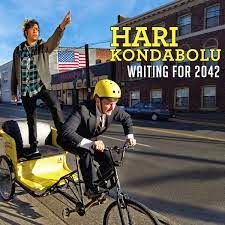


Hari Kondabolu – Waiting for 2042 (Kill Rock Stars)


Being a political comedian is much easier than being a political songwriter—but it’s still no walk in the park. Channelling your anger into humour, and simultaneously hoping to enlighten rather than just preach to the converted, is a rare talent. Hari Kondabolu has a master’s degree in human rights from the London School of Economics: he’s not here just to take cheap shots at Republicans. He will, however, relish in pointing out the illogical doublethink of racists who refuse to believe in a non-white Jesus or are worried about America’s white population becoming a demographic minority by 2042—which, as Kondabolu points out, is only even possible if you assume a) the other 51 per cent are all the same, and b) that all white people identify as one.


Kondabolu also delights in skewering those of his own political bent, especially his myriad friends who, frustrated with the state of America, continuously claim that they’re going to move to Canada. “Canada does not have a special visa for American liberal cowards. That’s not how the immigration system works!” Kondabolu hectors. He then goes on to debunk Canada’s good-guy reputation, and suggests that we look good only because the U.S. is so widely reviled around the world. “It’s like in high school, and there’s the dude who’s punching you in the face, every day, against your locker. Then his friend shows up and starts laughing. As the two of them start walking away, the dude that was laughing turns around and says, ‘Dude, I’m so sorry.’ That’s Canada!”


Kondabolu’s true brilliance, however, is not just his political or racial material, but his self-awareness (including his use of third person) and meta-jokes, in which he analyzes his own delivery and set-ups immediately after delivering a punchline—and sometimes the footnotes are funnier than the original joke. (Aug. 14)


Download: “My White Chocolate Joke,” “Toby,” “2042 and the White Minority”


Shamir – Northtown EP (Godmode)


Shamir Bailey is a 19-year-old from Las Vegas with a gorgeous, androgynous voice—that’s not a falsetto, folks. At the end of his disco-driven debut EP is a cover of Toronto country singer Lindi Ortega, a solo guitar-and-voice take on her song "Lived and Died Alone." It’s a shocking twist following four tracks of joyous dance pop that owes more than a few debts to early ’90s house music (which is undoubtedly on its way back; see: Kiesza). Apparently he’s also a huge Tegan and Sara fan and used to play in a punk band: this guy’s taste is all over the map. “I still don’t feel like there are too many artist around my age that are being very diverse with their music,” he told Pitchfork. The stark Ortega cover is the only evidence of his catholic interests on this EP; otherwise, he sounds like a musical sponge who’s been dwelling in discos his whole life, displaying the range and control of a veteran diva—especially on the show-stopping R&B ballad "I’ll Never Be Able to Love." Undoubtedly the most promising act of 2014. (Aug. 7)


Download: Everything you possibly can. Listen here


Spoon – They Want My Soul (Universal)
Operators – EP1 (Last Gang)


An interesting title choice for this band’s first major-label album in over 15 years. Yet little has changed for these critical favourites, who are still a minimalist rock band writing classic pop melodies with R&B swagger and experimental electronics hovering in the background. They’ve already sold hundreds of thousands of records and cracked the American Top 10, so it’s not like this album will suddenly break open new doors for Spoon: if you like Spoon, there’s plenty of Spoonness to like here, with fewer of the weird detours found on 2010’s Transference. It’s hard to fault a band this good for their consistency.


But if you love Spoon, you’ve heard it all before—and They Want My Soul is far from Spoon at their best, despite the fact they brought in outside producers for the first time: Dave Fridmann (Flaming Lips, Tame Impala) and Joe Chiccarelli (Morrissey, Shins). They certainly don’t need them, as drummer Jim Eno has been a principal architect of Spoon recordings since the beginning. (Eno also helmed Telekinesis’s 2013 album Dormarion, which is one of the best American rock records since Spoon’s 2007 album Ga Ga Ga Ga Ga.) Singer/guitarist Britt Daniel’s side project Divine Fits, whose 2013 debut flew under most people’s radar, contained both better songs and wilder detours.


Unfortunately, Divine Fits also outshines Operators, the new band by Daniel’s partners in that band: Dan Boeckner (Handsome Furs, Wolf Parade) and Sam Brown (New Bomb Turks). Boeckner has been surrounding himself with more and more electronics since the dissolution of Wolf Parade—which until now has worked well, especially on the Handsome Furs’ second album, Face Control. Yet Boeckner sounds best when he’s at least anchoring himself with a guitar slung over his shoulder; at the very least, it inspires him to write better songs than the five on offer here. (Aug. 14)


Download Spoon: “Inside Out,” “Do You,” “Outlier”
Download Operators: “Ancient,” “True,” “Start Again”


Mirel Wagner – When the Cellar Children See the Light of Day (Sub Pop)


Cheery title, that. This Finnish folk singer opens her album with a morbid minor-key children’s rhyme: “1, 2, 3, 4, what’s underneath the floor? / Chewed up lips, milky milk teeth, little bit of pain and a whole lot of need.” Things don’t lighten up from there. Not that you want them to: Wagner is so effective at creating a sparse and desolate atmosphere that any hint of redemption would seem disingenuous.


There’s very little decorating the skeleton of her and her acoustic guitar; she sounds like a ghostly girl discovered playing in a corner of your attic. It’s not just the instrumentation that’s sparse; so is her playing, almost amateurish in its rhythm if it wasn’t so obviously intentionally creating a mood. Her chord choices are right out of Nirvana’s Unplugged, a mixture of folk and blues motifs and occasional left-field chords borrowed from the Beatles or Pixies; her deadpan drawl recalls Townes Van Zant at times. Wagner keeps her songs short and sharp; yes, she delivers a downpour of dread, but never is it maudlin or obvious or remotely gimmicky. She’s a charismatic storyteller who can stop you dead in your tracks. (Aug. 28)


Download: “1 2 3 4,” “The Dirt,” “The Devil’s Tongue”

Tuesday, January 26, 2010

Jan '10 reviews

Quick plug: Stuart Berman will be hosting a live performances and interview with Charles Spearin, revolving around one of my favourite albums of 2009, The Happiness Project. It's free at Harbourfront Centre this Thursday night, Jan. 28.

The following reviews ran in the Kitchener-Waterloo Record and Guelph Mercury.


All Tomorrow’s Parties DVD (ATP/ Sonic Unyon)

All Tomorrow’s Parties is not a concert film; nor is it a documentary. Instead, it’s a series of snapshots of the 10-year-old U.K. music festival, interspersing live footage, candid shots of performers, and more than a few infuriating portraits of stoned British music fans goofing around in the seaside holiday resort where the original ATP festival is held (it has since expanded to put on events in London and in the U.S.).

What’s most fascinating about this countercultural celebration is the eclecticism: ATP takes pride in assembling iconoclasts whose only real common thread is a unique approach to their chosen genre of music—if they’re not already inventing new genres themselves.

And so the film opens with the danceable prog rock of Battles and closes with Grizzly Bear singing a cappella on a beach. In between we see visceral performances by stars and legends such as Portishead, the Yeah Yeah Yeahs, Patti Smith and Iggy Pop with the Stooges, as well as the comparatively unknown like the Balkan folk group A Hawk and a Hacksaw (playing acoustically in an arcade), poet Saul Williams and visceral crowd-pleasers Les Savy Fav. Not everyone is warmly embraced, however; there’s a painful clip of comedian David Cross being booed off the stage.

Cleverly interspersed with the modern doc footage is archival footage of British seaside vacationers from decades past, as well as various psychedelic effects that add to the stream-of-consciousness approach. The whole film functions as a surrealist dreamscape, without any narrative or particular point: just an immersive, ephemeral experience that overloads the senses. Not unlike an ATP weekend itself, no doubt. (K-W Record, January 21)


Boogaloo Pow Pow: Dancefloor Rendez-Vous in Young Nuyorica – Various Artists (Honest Jon’s)

Compared to the comprehensive compilations put out by reissue labels Soundway and Analog Africa, the relatively brief liner notes found inside this collection seem slight, as they attempt to explain the evolution of ’60s and ’70s Hispanic-American (mostly Puerto Rican) music as it morphed from mambo and cha cha cha into boogaloo and shingaling. And the tracks, some of which are licensed from EMI and Universal, are probably not terribly rare.

But who cares? Every track here puts a strut in your step, from the screamin’ hot “Cool Jerk” by Kako, to the insanely tense build-up in Manny Corchado’s “Pow Wow,” to solid tracks by better known artists like Tito Rodriguez, Willie Rosario and Ray Barretto. The horns are blazing, the rhythms are unstoppable, and the whole thing is a party in a can. Other compilations can try and contextualize all they want: on this one, every single track speaks for itself—and it’s commanding you to dance. (K-W Record, January 7)


5 Years of Hyperdub – Various Artists (Hyperdub)

Arguably, the genre that U.K. critics call “dubstep” is just the latest semantic shellgame for the ongoing evolution of electronic music. In this case, it’s dark, often doomy beats that mine everything from Kraftwerk to Jamaican dub reggae to Timbaland’s take on hip-hop, with staggered beats, jittery synthesizers and a sparse, icy sheen best suited to late night chill-outs, no matter the tempo and despite the occasional abrasion.

In what is largely a singles-based scene, Burial and Kode 9 are the two key dubstep artists (actually, the only ones) to have made a mark with full-length albums. And it’s easy to hear why: their tracks here (three from Burial, five from Hyperdub founder Kode 9) leap out from the rest of the pack and display an inventiveness that can easily stretch out to an album’s length. Burial lets snippets of sound slowly sink into the dub mix, building maximum tension as he decides what to reveal from behind the curtain, while subsonic bass and disembodied vocals cast hypnotic spells. Kode 9 constructs soundscapes like the Wu-Tang Clan’s RZA raised on reggae instead of dusty soul records.

Outside of the two principals—and the almost-as-well-known (and that’s entirely relative, of course) Zomby—5 Years of Hyperdub offers mostly diminishing returns. Media hyperbole notwithstanding, dubstep is hardly revolutionary enough to the point where even its lesser lights are fascinating. Of the 15 other artists on this 32-track double CD, only Darkstar, Joker and Black Chow leave any kind of impression. L.A.’s Flying Lotus is the only non-Brit invited, and he sounds like he’s on a whole other trip entirely; meanwhile, The Bug, who predates dubstep, sounds like he dusted off something horribly dated from 10 years ago rather than his far superior new material.

Casual observers would be better off sampling Kode 9 or Burial; the rest is recommended as a time capsule for serious explorers only. (K-W Record, January 14)


Legends of Benin: Afro-Funk, Cavacha, Agbadja, Afro-Beat 1969-1981 – Various Artists (Analog Africa)

Every year there is no shortage of African compilations that hit the market, but only in recent years has this niche market taken off: thanks in large part to two record labels, Soundway in the U.K. and Germany’s Analog Africa. You can’t go wrong with anything in their collective catalogues, but of the hundreds of dollars I’ve spent on their albums in the last couple of years, one album stands heads and shoulders above the rest: Legends of Benin.

On the surface, Legends of Benin has what every great African comp has: a mix of Afrobeat, American funk, Latin rhythms and jazz. But the four artists focused on here— Gnonnas Pedro, El Rego, Honoré Avolonto and Antoine Dougbé—share an entrancing aesthetic that sheds busier arrangements and leaves plenty of sonic space for deep bass lines, owing more than a bit to not just James Brown but Jamaican reggae, even if only one track here draws any direct reggae influence (Avolonto’s “Tin Lon Non”). Each man is a compelling vocalist, whether they’re screaming over furious funk or crooning over languid guitar rhythms.

Though this all may appear par for the course, compiler Samy Ben Redjeb has hit the goldmine with these four men, as every single track here is nothing short of mindblowing, from the opening dancefloor killer of “Dadje Von O Von Non” to the haunting closing lament of “La Musica en Verité,” both by Gnonnas Pedro. Sure, these compilations are pricy, but know that a), Redjeb goes to great trouble to track down the artists and compensate them or their families accordingly (as detailed in his fascinating travelogue liner notes), and b), it’s worth every hard-earned cent. (K-W Record, January 7)


Magnetic Fields – Realism (Nonesuch/Warner)

The sincerity of songwriter Stephin Merritt is often questioned; and in return, Merritt questions why we demand sincerity and earnestness from our songwriters—especially those with acoustic guitars. When the Magnetic Fields use synths or hazy waves of distorted guitars, it’s easier for listeners to appreciate the hilarious narratives and rhyme schemes that Merritt employs regularly, even though there is often serious heartbreak and pathos in those same songs.

And so here, on an album where the instrumentation is entirely pre-rock’n’roll era—and which actually features a song called "We’re Having a Hootenanny Now"—Merritt continues to balance what can be dismissed as novelty songs with more serious fare. More often than not he attempts both at the same time, employing witty wordplay to illustrate emotional complexity, which is Merritt’s specialty.

Musically, Merritt defines Realism with ukuleles, mandolins, toy pianos and cello countermelodies colouring all the songs here; synths and drums are verboten, and electric guitars are rare. Shirley Simms and pianist/percussionist Claudia Gonson share vocals with Merritt, recalling the Magnetic Fields’ defining work, 1999’s 69 Love Songs.

Indeed, much of Realism sounds vaguely familiar: several tracks sound like they could have been culled from various other albums in the Merritt discography. Longtime fans might wish Merritt would take his own advice from one of the songs here: “Do something out of character/ anything/ do something true.”

And yet, being the master craftsman that he is, it doesn’t at all sound like he’s stuck in a rut; each song stands with his best, making it an ideal entry point for anyone unfamiliar with his massive body of work.

That said, if you find the idea of a man chorus singing a verse in German on a song called “Everything is One Big Christmas Tree” to be more nauseous than novelty (or, more accurately, a comment on consumerism plastic smiles), then Merritt’s Magnetic Fields are a taste you’re unlikely to acquire. (K-W Record, January 28)


Olatunji! – Drums of Passion (Sony Legacy Edition)

This Nigerian percussionist is credited with bringing African drumming to the American mainstream—influencing John Coltrane, Carlos Santana and the Grateful Dead, and leading to performances at Kennedy’s inauguration and at key Martin Luther King Jr. rallies. This 50th anniversary re-issue offers ample reasons why, with a gorgeous remastering job, informative booklet, bonus tracks and the 1966 follow-up More Drums of Passion as a bonus disc. The latter, recorded by Miles Davis’s producer Teo Macero, is arguably even more fascinating, more frenetic and more accomplished.

Sure, there are more than a few moments that make you feel like you’re trapped at a folk festival drum circle—until you realize that not only is Olatunji a true master, but this is the album that changed the way North Americans thought about music. The percussive onslaught is impeccably arranged and augmented by gorgeous choral chants (think: Gainsbourg’s “Couleur Café”) and, on the bonus tracks, some jazz instrumentation as well, which works perfectly and is a welcome change of scenery.

Sony’s Legacy Edition imprint is one of the only major labels to do loving reissues properly, and though this isn’t likely to be one of their bigger sellers, it’s treated with appropriate reverence. (K-W Record, January 7)


Panama 2: Latin Sounds, Cumbia Tropical & Calypso Funk on the Isthmus 1967-77 – Various Artists (Soundway)

Panama 3: Calypso Panameno, Guajira Jazz & Cumbia Tipica on the Isthmus 1960-1975 – Various Artists (Soundway)

The most fascinating reissues of recent years have focused on cross-cultural clashes: Ethiopiques, Cambodia Rocks, many of the Sublime Frequencies releases, etc.

In a geographical centre like Panama, however, anything and everything goes: there is plenty of American jazz with Latin rhythms—as had already been popular in the U.S. for at least 20 years by the time these recordings were made—but also heavy influences from the Caribbean and Colombia, and similar strains heard in Afro-funk, to say nothing of the subtle influences from the diverse group of international migrant workers that were brought to Panama to finish the canal in the early 20th century.

And so here we have Latin jazz, R&B, calypso, salsa, merengue and even some raw garage rock guitars. Peculiar to these compilations is the Panamanian style of tipica, which is related to the slow Colombian cumbia, though often featuring accordion and sharper percussion. Compiler Roberto Ernesto Gyemant goes to great detail in his engaging lead essay for both compilations, as well as with notes on individual tracks.

Not only does Gyemant know where to find the quality rarities, he knows how to sequence them. Both comps move effortlessly from sparse calypso to raging big band jazz to percussion-heavy tracks like Ceferino Nieto’s “El Pajaro Zum Zum,” which features a monstrous drum break that’s bound to end up in a killer hip-hop track before the year’s end—in fact, nothing else seems to happen in the song, except huge drums, subtle bass, and Nieto screaming in incomprehensible English like James Brown with an itch he can’t scratch.

For a breather, there is the slow, deep funk of Los Silvertones’ “Carmen,” with its Funkadelic guitars and Ethiopian-sounding saxophones, or the slinky groove of the Duncan Brothers’ “Dreams,” or the lilting reggae of Sir Jablonsky’s “Juck Juck.”

Only a few artists appear more than once; it’s not hard to fall in love with the calypso crooner Lord Cobra or the psychedelic sounds of Los Silvertones. But even amidst the wealth of artists heard here, there’s shockingly little repetition stylistically, which means neither of these compilations ever wear out their welcome. (K-W Record, January 21)


Yoko Ono Plastic Ono Band – Between My Head and the Sky (Chimera)

It shouldn’t surprise anyone who’s ever heard any of her music that Yoko Ono, at age 66, is still wonderfully weird. Certainly, there are placid moments and musing on mortality on her latest album. But right from the opening track, “Waiting for the D Train,” she’s wailing and cackling over garage rock guitars and post-punk dance grooves—showing the likes of Karen O who’s still the boss.

For all the ridiculing she’s endured over the decades, she’s been largely vindicated by new generations of musicians who try to push the envelope in ways they later discover Ono was doing 35 years ago. And so Between My Head and the Sky is a victory lap for her, as she leads a funky band helmed by her son Sean and Japanese electronic artist Cornelius, and continues to use her voice in ways precious few singers do (for better or worse). The only serious pitfalls are the more maudlin pleas for peace on tracks like “Healing,” which haven’t grown any more complex since the naïve absurdity of the bed-ins.

Ono’s timing is perfect: not because of the much-ballyhooed Beatles reissues of 2009, but because people like the Flaming Lips, Bjork and other freaks have crept closer to the mainstream, and combined with the strength of this album, it’s the perfect time for skeptics to take a second look. (K-W Record, January 28)


RJD2 – The Colosuss (Electrical Connections)

There was a time when a DJ album meant certain things: sampling, scratching, hip-hop beats, techno. These days, however, a DJ is expected to be more eclectic, both in the club and on CD. RJD2 has expanded beyond the cinematic hip-hop that defined his earlier work—the kind that attracted the producers of TV’s Mad Men, who picked one of his tracks as their theme song—and made a diverse pop album that includes everything from harpsichord funk (“Giant Squid”) to spy movie themes (“The Stranger,” “Small Plans”) to ’80s R&B and swinging ’60s pop (“Walk With Me”).

Musically, he pulls it off with aplomb—he’s slowly been moving from an entirely sample-based artist to a multi-instrumentalist. It’s the tracks with vocals that stop The Colossus from greatness: not that the singing is bad, either by RJD2 himself or guest vocalists, but he hasn’t really figured out how to work with a vocal melody yet—because until now, he’s successfully focused on letting the music do all the talking. Ironically, this would be a better pop album if it didn’t have any vocalists on it. (K-W Record, January 28)


Spoon – Transference (Merge)

Few rock bands take minimalism to the max the way Spoon do, stripping away all excess fat and focusing on the bare essentials. It’s an approach that worked to brilliant effect on their 2002 breakthrough Kill the Moonlight, which took an approach almost akin to dub reggae, in terms of what instruments would suddenly drop out of the mix and when.

After two slightly more conventional—and increasingly popular—albums, Spoon have now pulled everything back again to make the sparsest album of their career. Unfortunately, it doesn’t work as well this time. Far too many songs find the entire band chugging away on the same quarter note, in a fashion more suited to demos than a finished product. It could be that this is their point: leaving so many blank spaces to let the listener project whatever they want between the lines. Or it could be just lazy.

This being Spoon, however, all is not lost. Five of the album’s 11 tracks show signs of former brilliance (“Mystery Zone,” the 2009 single “Got Nuffin”); “Who Makes Your Money” is a trippy take on opiated R&B; closing track “Nobody Gets Me But You” channels early-’80s Prince and the minimalist funk of ESG. “Goodnight Laura” is an uncharacteristically straightforward piano ballad.

Those are the only songs where it sounds like they’re actually trying; too much of Transference sounds like they just gave up. (K-W Record, January 21)


Vampire Weekend – Contra (XL)

For whatever reason, this young band’s debut album proved to be remarkably divisive. For every fan won over by their innocent charm and breezy songwriting, they faced a nasty detractor put off by their preppy ways.

Contra is bound to meet the same fate, as Vampire Weekend unspool some of their arrangements to explore different textures, and use the studio more creatively than merely capturing their live sound and adding a string section. Here, they appear to have been listening to New Order, ska, soca, and surf rock, all of which collide with varying degrees of success. Multi-instrumentalist whiz Rostam Batmanglij has no shortage of inventive ideas, but deciding to let vocalist Ezra Koenig use Autotune on the dreadful “California English” was not one of them.

If Batmanglij is the band’s secret weapon, Koenig is their not-so-secret albatross. His lyrics, which at best are cute and clever, are mostly cloying and clunky on much on Contra—no more so than on the horrific closing track, “I Think UR a Contra,” which may or may not have something to do with a couple comparing their communication with right-wing Nicaraguan rebels of the ’80s. Or whatever. The listener’s first warning is when Koenig leads off the album with the couplet: “In December, drinking horchata/ I look psychotic in a balaclava.”

Maybe the South African township jive they love so much has equally inane lyrics—who knows? For English speakers, Koenig is largely a dippy distraction from an otherwise interesting band, one that shows signs of successfully dodging a sophomore slump. (K-W Record, January 14)


Hawksley Workman – Meat (Isadora)

The last time we heard from this prolific performer, he had released an album with the ridiculous title Los Manlicious, where he tapped into the swagger that has defined his most sublime moments. That swagger is still there, and Workman is indulging some of his wilder urges on tracks like “(We Ain’t No) Vampire Bats,” while still allowing room for intimate moments like the piano ballad “Song for Sarah Jane” and the anthemic R&B slow jam “The Ground We Stand On.”

But if the performances and the production bring out the best in him, aside from the aforementioned standouts Workman’s songwriting doesn’t measure up. The lyrics are as whimsical as always, and you’ll either love or hate his odes to baby mosquitoes, Tokyo bicycles, and French girls in L.A.

The problem is that none of the tunes demand the enthusiasm that he creates in the studio for them; maybe they’ll come across better live. If not, fans won’t have to wait long for his next album, Milk: the single, “We Dance to Yesterday,” is already out and the album is due in the spring. (K-W Record, January 28)